

-
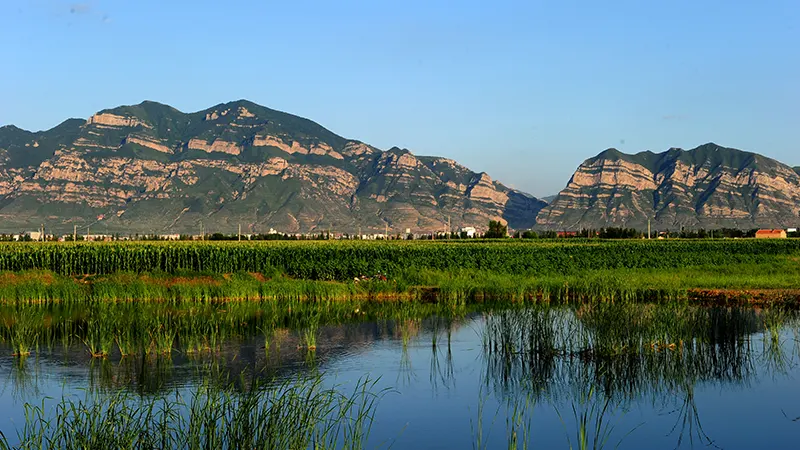
AboutMount Heng, an outstanding representative of the splendid mountains and rivers of China, a symbol of national prosperity, a totem of national spirit, an important geographical indication of the country, and holds the status of a national mountain.More
-
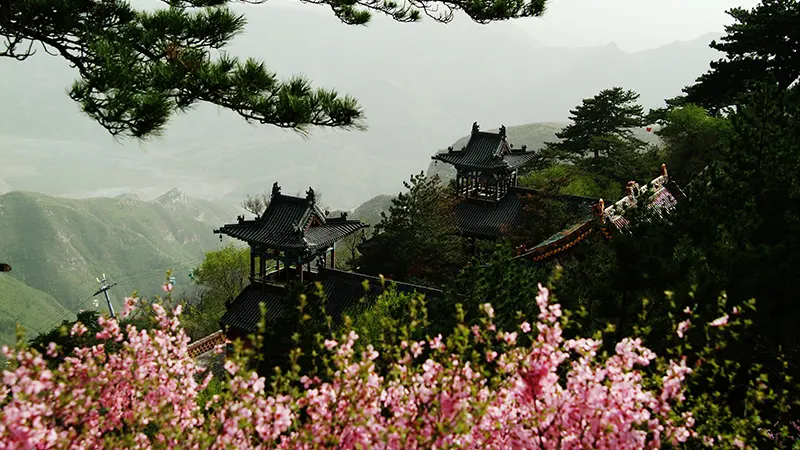
CultureHengshan has been a famous scenic spot and important birthplace of Taoism in northern China since ancient times. Carrying the symbols of Chinese civilization, it has nurtured profound regional culture and folk customs.More
-
-
Tourist GuideUnderstand relevant information about the scenic area and enjoy a better travel experience.More
-
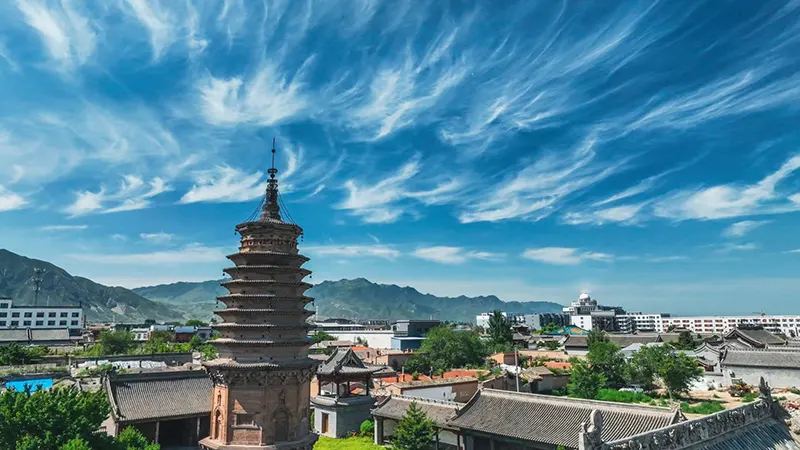
Surrounding activitiesThe ancient city of Hunyuan at the foot of Mount Heng in Beiyue has a long history, rich cultural heritage, beautiful scenery, and a convergence of agriculture, commerce, and animal husbandry. It has nurtured a unique regional culture and is renowned for its fine wine and delicious food.More






Wu Shaocheng's 1926 Hengshan Mountain Travelogue (Republic of China period)
Publish Time:
2025-03-17 09:44
Source:
Wu Shaocheng, a Jiangsu native and teacher at a certain school in Taiyuan, had long admired Mount Wutai and Hengshan Mountain. In October 1926, he set out on a journey to visit them. Despite the rugged mountain paths, he traveled alone, first to Mount Wutai and then to Hengshan Mountain.
Editor's Note
Wu Shaocheng, a Jiangsu native who taught at a certain school in Taiyuan, had long admired the names of Mount Wutai and Hengshan Mountain. In October 1926, he set out to visit them. Despite the rugged mountain paths, he traveled alone, first to Mount Wutai and then to Hengshan Mountain.
While visiting Mount Wutai, Wu Shaocheng happened to meet Monk Kaicheng, a fellow villager residing at the temple, and they then decided to travel together on foot to Hengshan Mountain, with their luggage carried by a hired porter. On October 24th, Wu Shaocheng, Monk Kaicheng, and the porter set off from the East Peak of Mount Wutai, passing through Hongmenyan Ridge, Lion Ridge, crossing the Shahe River, and beginning their ascent from the southern foot of Hengshan Mountain on the north side of the Fan Shi Daying. They passed through Poidui Jius, Xini Gou, Zhujiafang, Wuzhangpu, Longpengyu, and Daziciyao, arriving at the main peak of Hengshan Mountain on the 29th. On the 30th, Monk Kaicheng, having finished touring Hengshan Mountain, bid farewell to Wu Shaocheng and returned to Mount Wutai with the porter by the original route. Wu Shaocheng, however, had a temple boy from Hengshan Mountain serve as his porter and guide, going around the back of Hengshan Mountain to the Hanging Temple, then heading north to Hun Yuan City, and lodging at the Taishan Grandma Temple in the southern alley of the bell tower.
At that time, the Fengtian clique, Zhili clique, and Shanxi clique united to drive out Feng Yuxiang's National Army. The National Army, retreating from Beijing to the Northwest, engaged in battle with the Shanxi Army in North Shanxi, and the defeated National Army was driven to the area around Wuyuan in the Northwest. Hun Yuan was located in the midst of the conflict between both armies. The war brought various hardships to the people, and Wu Shaocheng heard accounts of the war from many local people, collecting firsthand oral histories of this war, which deserves attention and significance for researchers of the North Mountain region's history.
In Hun Yuan City, Wu Shaocheng visited the Hun Yuan Middle School and the Girls' School, and was deeply impressed by the magistrate's boots hung on the city gate and the beauty of Hun Yuan women. He also specifically bought more than ten kilograms of astragalus at a pharmacy in the county town, planning to take it back home as a local product from Shanxi Province to give to relatives and friends, demonstrating the popularity of Hun Yuan astragalus at that time. On November 2nd, Wu Shaocheng hired a mule to leave Hun Yuan, but due to snow, he returned to his lodgings at the Sanyi Hotel outside the south gate. On the 3rd, he continued westward, passing through Xifangcheng to Yingxian; then he went to Shanyin City and arrived at Guangwu Town next to the Yanmen Pass on the 5th, entering through the pass; arriving in Xinzhou, he stayed at the Yisheng Hotel outside the city; on the 7th, he took a rickshaw and returned to Taiyuan, the provincial capital, in the afternoon, ending his journey.
Wu's "Hengshan Mountain Travelogue" was written in the autumn of 1926 and published in the Winter issue of Volume 1 of "Travel Magazine" in 1927. Due to limitations in memory or verification, the place names and distances recorded in the article may not match the actual situation. In order to maintain the original appearance, the editor has not made any corrections. We hope readers will discern these themselves, to avoid the error of clinging to old ideas.
Travelogues of modern figures visiting Hun Yuan and Hengshan Mountain have always been a focus of this journal. This article is now published for the benefit of readers.

Hengshan Mountain Travelogue (Including a Yanmen Pass Travelogue)
Wu Shaocheng
October 24 to November 7, 1926
Having completed my journey to Mount Wutai, I then traveled with Monk Kaicheng to Hengshan Mountain. Famous travelers in the past include Xu Xiake; in recent times, there is Jiang Weiqiao. The mountain's location is rather remote, making it difficult for tourists to reach. The mountain is about 400 li from Mount Wutai, located to the northeast of Mount Wutai, belonging to Hun Yuan Prefecture in Datong Prefecture, Shanxi Province, and is the North Mountain among the Five Great Mountains. Traveling north from Mount Wutai, the route is all mountains, and the two of us traveled on foot.
October 24th
Descending from the East Peak of Mount Wutai to Hongmenyan Ridge, the mountain was high and steep, with snow several feet deep. I once slipped and fell, sinking my feet deep into the snow, causing my companion to clap with laughter. From this, one can see how difficult the journey was. Traveling northeast from the ridge, the ground gradually sloped lower as we descended into a valley. We saw numerous rocks and withered trees and shrubs along the way. After twenty li, we reached Taipinggou, walking through the mountain stream, and then climbing again. The mountains grew deeper and higher, and the path wound around peaks. I relied on our guide. Otherwise, I would not have known which path to take. By this time the sun was setting. We reached a peak and climbed to the top, looking down at the surrounding peaks stretching out below. The mountain air was filled with mist, and the setting sun was obscured by the clouds, sometimes appearing, sometimes disappearing, sometimes red, sometimes purple, sometimes round, sometimes oval, sometimes above the clouds, sometimes below them, like floating and sinking, the peak itself also seemed to float and sink in the mist. Although this sight could not compare to the magnificence of the sunrise on Mount Tai, it was still a wondrous sight. In heaven and earth, there are wonders everywhere, but one cannot appreciate them unless one witnesses them in person. By the time night fell, I had forgotten that I was in the wild mountains. I rested when I was tired, and fortunately, there was snow on the path, which emitted light in the dark, though one had to walk carefully. After less than ten li, we arrived at Yechang, where we stayed the night.
October 25th
The weather was clear. At six in the morning, we got up, packed our bags, and headed north. The snow grew deeper along the way, and the mountain path was more rugged than before. Rocks blocked our way and streams gurgled. At noon, we passed Lion Ridge. Our lunch was mountain food, which was not very palatable. The food consisted of oats, which are quite cold in nature, and require three stages of processing before people can eat them. The three stages of processing refer to roasting the ripe oats in a pan, the first stage; grinding the roasted oats into flour and steaming them, the second stage; steaming the steamed flour again into various foods, the third stage. Besides oats, there were potatoes in the mountains. I like to eat potatoes, and when I reach a place, I always first ask if there are potatoes, although I sometimes eat oats. After lunch, we headed north and reached the foot of the East Mountain. From afar, the trees in the mountain did not yet show any signs of winter. Willows swayed gently in the wind, graceful and elegant, as if welcoming us who came to visit at this time. We found an inn in the foothills and rested there.
October 26th
As dawn broke and the mountain birds began to sing, I got up and put on my clothes. Leaving the inn, I headed north, walking through a stream. This was the end of the mountains, and the road became gradually flatter. Looking back at the road, the two mountains hugged each other, with a stream flowing between them, a truly beautiful scene. Going through villages and across farmlands to the north, along the way, I saw fields stretching as far as the eye could see, entirely flat fields. The oat seedlings had already sprouted, full of life, a lovely green. Looking around, mountains surrounded us on all sides, filling my heart with a sense of exhilaration; this was a large plain in the middle of the mountains. After ten li, we arrived at the Shahe River. From there, we traveled northeast; the earth was rolling hills and easier to walk on; the snow had mostly melted. At six o'clock, we arrived at Daying and spent the night there.
October 27th
North of the large camp, ten li up the mountain. Winding upwards, the mountain gradually rises. Many people come and go transporting goods from the mountains, especially rhubarb. This mountain area has many rhubarb plants, some as high as five feet, making it a local specialty. Its price is quite low, only two or three cents per catty. If this goods is transported to a pharmacy in the south, the price will be eight times higher. At six o'clock, we arrived at Puo Duijiu Village, with dozens of households located halfway up the mountain. We couldn't find an inn, which was frustrating. This happened after the war, when the people suffered from the army and their situation was unbearable, leaving nowhere for travelers to stay. In the deep snow and night, we couldn't go any further, and since there would be no inn for 30 li, we had no choice but to resort to forceful means. We inquired about the village head, stating our arrival from the provincial capital, urging him to come quickly. Hearing our words, the villagers had already sent a messenger. In a moment, the village head came, and when asked why there was no inn, he replied that it was due to the unrest following the war. He then invited us to stay at his place. The evening meal included steamed buns, eggs, etc., and the hospitality was quite courteous. Having traveled for three or four days, I never expected such hospitality in the absence of inns. Haha, forceful means had to be used, which is rather amusing.
October 28
We woke up in the morning, the rising sun hidden by the eastern mountain, and the villagers were already working in the fields. After bidding farewell to the village head and thanking him, we went down the mountain and north. Walking through the mountain stream, the stream was already frozen. We passed the stone quarry, gradually ascending, and in the distance saw city walls on top of the mountain. In a short while, we arrived, and looking at the map, it was an old Great Wall. The bricks were not intact, and many sections were missing. Going out of the city to the north, we reached the Xin Ni Gou, walking in the shade of the mountain. The road was like a cut wall, less than a foot wide. A single misstep could endanger life. Looking down from here, people and horses looked like ants, and the shepherds' voices echoed through the valley. We descended to the halfway point and were blocked by mules and horses, so we rested for a while until they passed before slowly descending further. After more than ten li, we reached Zhujiafang and proceeded along the Hutuo River to Wuzhangpu, where we stayed for the night.
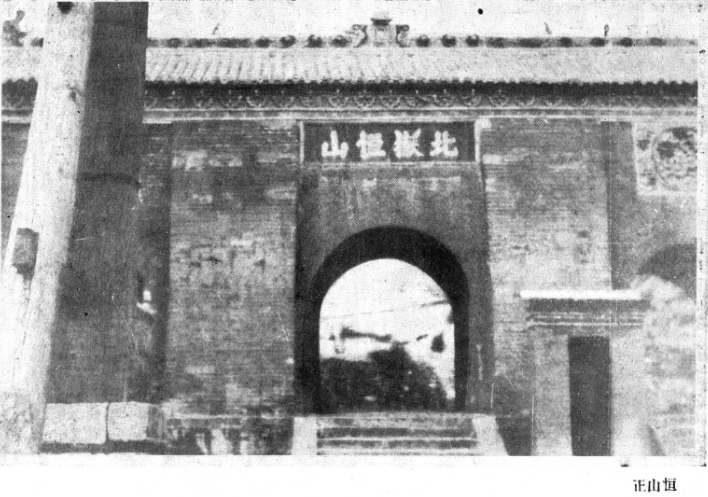
Hengshan Mountain Main Gate
Original illustration from "Hengshan Mountain Travelogue"
October 29
At dawn, the sky was full of colorful clouds, the mountains were dark and gloomy, and wild birds were singing. Going out of the inn to the north, we reached Heishi Ridge. There were many rocks on the road, some as large as oxen and elephants, and others as small as pigs and sheep, creating a strange and frightening sight. Many of the stones were dark in color, quite hard in texture, and containing iron that could be smelted. The stream flowed disorderly, making gurgling sounds. Suddenly, there was a stream too wide to cross, blocking our way forward, so we walked along the stream and found a large ice sheet with a hole underneath, through which water trickled. We crossed the stream using this ice sheet. It was about seven or eight feet long, and we called it an "ice bridge," which is not unreasonable. After this, we crossed the water to enter Longpan Valley.
Going further, there was a large market, with a dense population. Upon inquiry to the locals, we learned that it was a large porcelain kiln. Coal was produced here, with several mines, and its price was quite low, only two or three cents per catty. Children in the mountains would use three or four copper coins to buy forty or fifty catties of coal, and could get two or three times the price in the market. From here, we followed the foot of the mountain to the north, and upon reaching the end, turned west. After several li, Hengshan Mountain came into view. After less than four li, we reached the foot of the mountain, where there was a small town and market, with the people making their living from paper, which utilized water from the mountain spring.
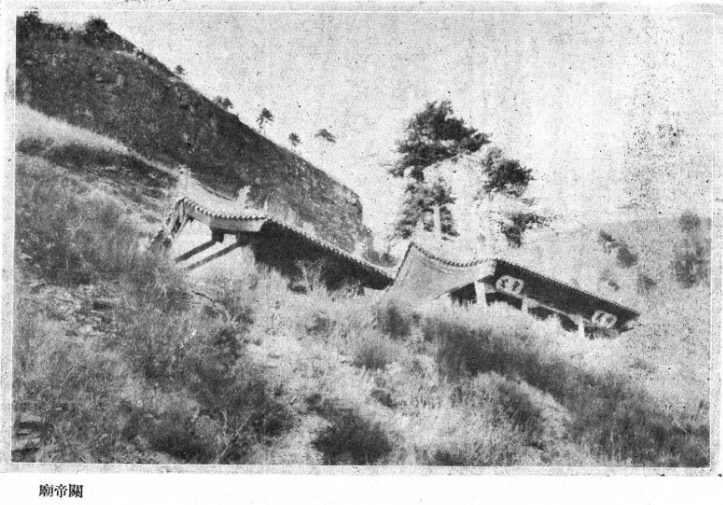
Guan Di Temple
Original illustration from "Hengshan Mountain Travelogue"
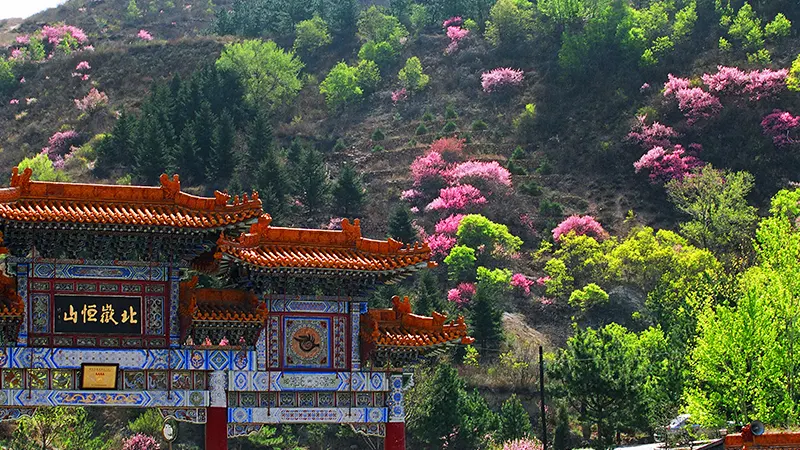
We went through the town, winding our way up the mountain. At the entrance of the mountain, there were tall gate towers with the words "Divine Power Supporting the Dynasty" written on them. After climbing 78 steps, we reached the gate of the gate tower, next to which there was a stone tablet inscribed with "The First Mountain in North China." Entering the main gate with the words "Hengshan Mountain" written on it, there was the San Yuan Palace and Guan Di Temple to the left. Going east from here, five li to Ting Zhi Ridge, the place where emperors stopped during their mountain sacrifices, hence the name. There was a Dragon King Temple on top, with broken tablets and rubble everywhere, showing signs of long-term neglect.
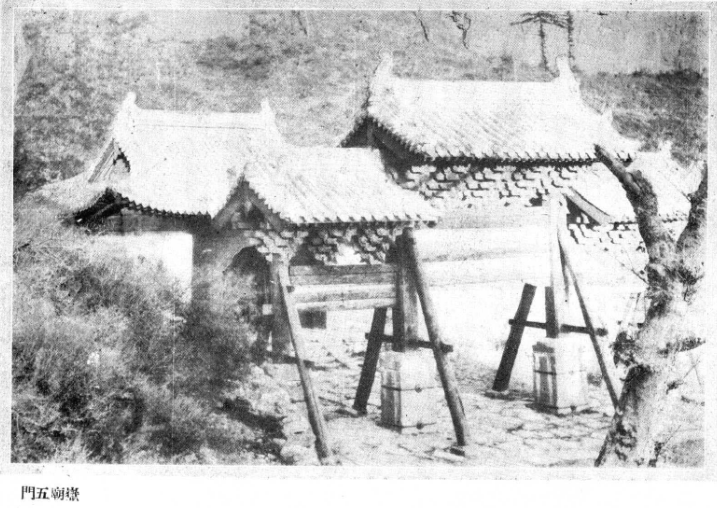
Five Gates of the Yue Temple
Original illustration from "Hengshan Mountain Travelogue"
Turning north from here, we reached Ping Zhi Ling Village, with four or five households and seven or eight shepherds playing. When they saw us, they hid. North of the village was Zhang Wang Temple, with three or four pine and cypress trees in front, their dark green color standing out against the white snow. Snow accumulated in clumps on the branches, which had yet to fall, providing a beautiful sight.
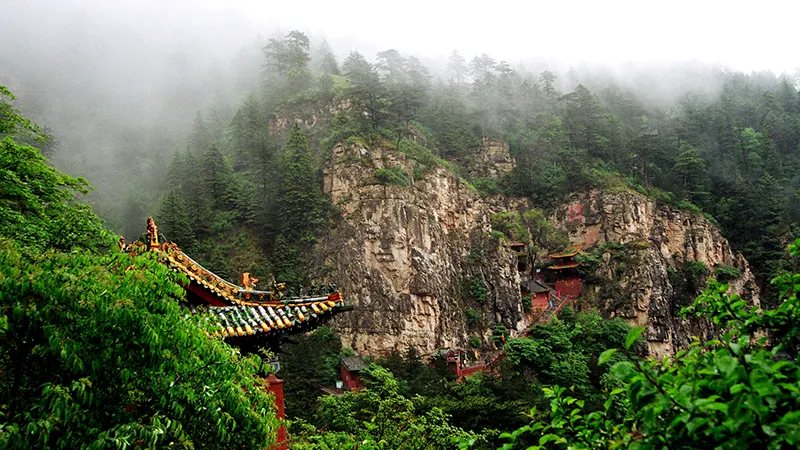
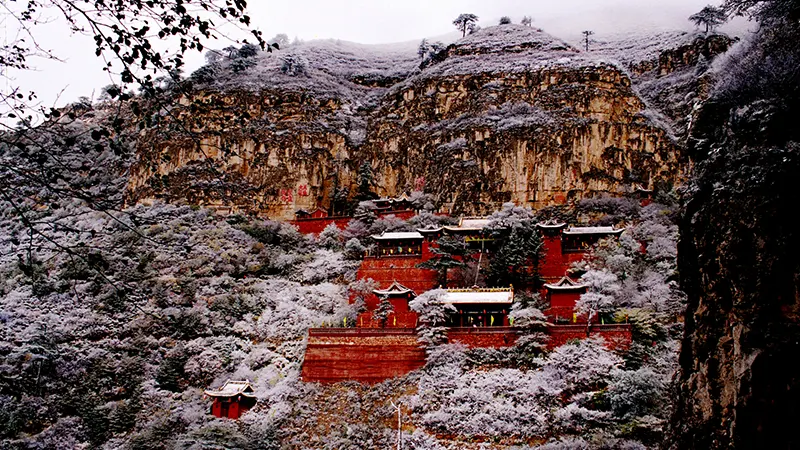
Continuing north, we gradually climbed higher, walking along the mountainside. In front was a gate tower with the words "Tiger Wind Mouth" inscribed on it, above which the high peak had rustling pines. Inside the gate was a stone tablet with the words "Jie Shi" (Jie Stone), written by Dong Xi during the Hongzhi reign of the Ming Dynasty. There was also a stone inscription offering tea, and further ahead was Jinlongkou, also carved on the mountain stone. This peak is Guolao Ridge, named because Zhang Guolao of the Eight Immortals rode his mule here. There are still mule footprints on the stones, where the mule's hooves caused cracks, and the cracks remain visible to this day. Alas, the mule of the immortal, its hooves were so sharp as to crack stones, I do not entirely believe it. Here, the stone road is relatively wide, about ten feet, and we took a rest here. We sat on the ground, and looking north, the high peaks rose up sharply. Underneath the peaks were rows of temples, and it seemed to be a fairyland. This was the main temple of Hengshan Mountain, and also the destination we desired to reach, as there is no higher point to climb.
After resting for a while, we got up and continued north. After three li, we turned east and entered the gate tower with the words "Forever Establish Hope" and on the back "North Yue Hengzong," the writing thick and powerful, but unfortunately, the author's name was not signed. Here we again sat on the ground, looking back at our journey. The winding path looked like hanging cloth, with countless mountains surrounding us. After resting, we continued our journey, passed Liquan Pavilion, where the Hongwu Stele was located. Inside the pavilion was a spring divided into two wells, about three or four inches apart, and yet their water was different in sweetness and bitterness, which was also strange. East of the pavilion was a cliff with "White Cloud Spiritual Cave" carved on it. Turning down from the cliff and heading north was difficult. Reaching the foot of the South Heavenly Gate, we passed a gate with the words "Chongling" on its plaque, and a stone inscription to its right, written during the Qianlong reign. Entering the gate, we climbed one hundred and three steps to reach the main hall of the South Heavenly Gate, where we saw many stone inscriptions from various emperors of the Ming and Qing dynasties about their mountain sacrifices. We then walked along the west corridor to the Taoist monk's quarters, where we were hospitably received and rested.
At 8 pm, we borrowed the "Hengshan Mountain Records" from the Taoist priest to read. Hengshan Mountain has a total of eighteen scenic spots: Buyun Valley, Wangxian Pavilion, Hufengkou, Tongxuangu, Baiyuntang, Qianlongquan, Xuyangyan, Guolaoling, Baihufeng, Qinqitai, Huixianfu, Dei An, Cuixue Pavilion, Jixian Cave, Zizhi Valley, Bifengzang, Shizhi Picture, Bailong Cave. In addition, there is Hanging Temple, but since it is located at the foot of the mountain, it is not included in the eighteen scenic spots. The record mentions a magical plant called "Protective Gate Grass". People would harvest this plant and hang it on their doors. If someone came at night, the grass would shout at them. However, this plant is now extinct.
The Taoist priest told me that in this war, our mountain will be the first to bear the brunt of the attack. West of the mountain is Hunyuan County. If the enemy comes, they will first occupy our mountain, as it offers a commanding view of Hunyuan. The temple's belongings have been emptied. My master is traveling and hasn't returned; only two or three people remain. The Hengshan Mountain seal, originally made of gold during the Zhengde era of the Ming Dynasty, is now kept in the county magistrate's treasury. The one currently used is a wood carving with the inscription “Hengshan Mountain, the Heavenly Yuan Seal.”
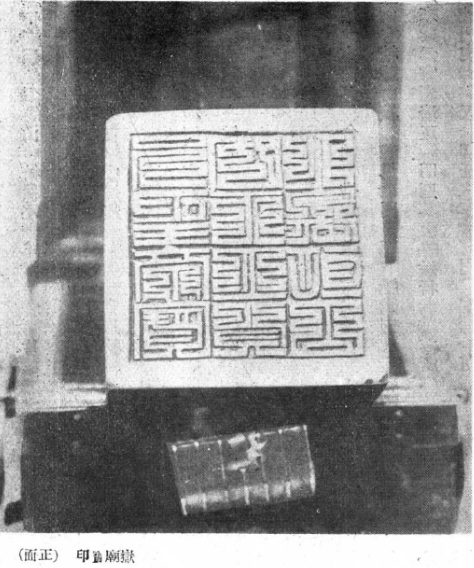
Yue Temple Seal (Front)
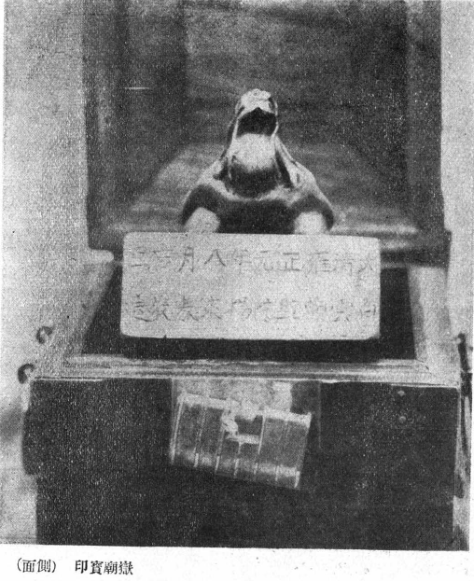
Yue Temple Seal (Side)
Original illustration from "Hengshan Mountain Travelogue"
The Taoist priest also gave me a seal made of bamboo and cloth, saying it was made from the gold seal and could protect the house. I accepted it with thanks and then lay down to rest.
October 30th
I woke up before sunrise, while the mountains were still asleep. The cold was intense, probably due to the high altitude. After washing, I had breakfast and went with Monk Kaicheng to the Zhenyuan Hall to perform a ceremony. The hall was dedicated to Taoist deities. After the ceremony, Monk Kaicheng drew a divination stick, and I followed suit. I got a stick with the same inscription as the one I received at the Long Temple on Mount Wutai. How strange!
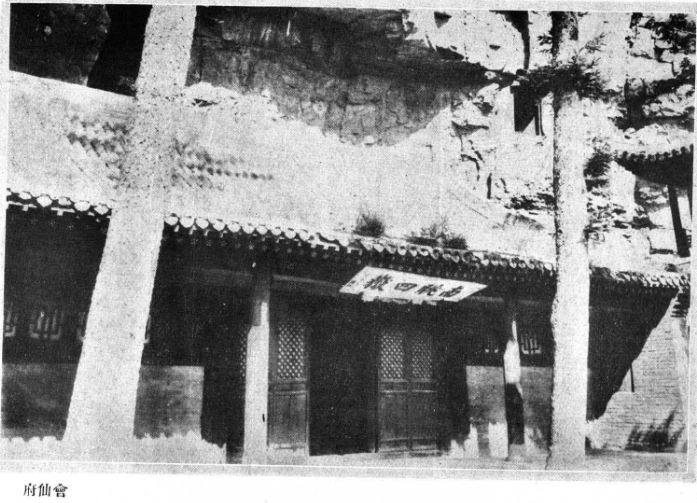
Hui Xian Mansion
Original illustration from "Hengshan Mountain Travelogue"
West of the hall is an imperial pavilion with an inscription by Emperor Qianlong. West of the pavilion is the Hui Xian Mansion, with statues of immortals inside. The mansion is located below a cliff, which has many inscriptions such as “Magnificent Heaven and Earth,” “A Thousand-Foot Cliff,” “Path to Heaven,” “Towering Clouds and Mountains,” and “Famous Mountain of the World.” The characters are as large as a fist. East of the mansion is a cave called Ji Xian Cave, and further east is a guest room.
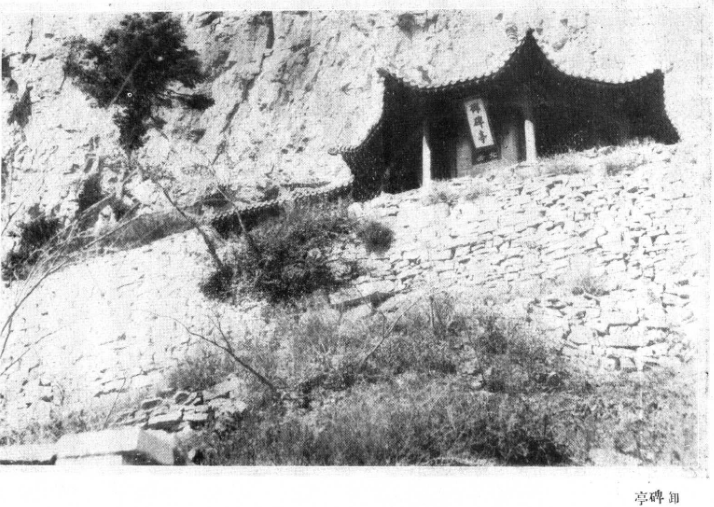
Imperial Pavilion
Original illustration from "Hengshan Mountain Travelogue"
There are many stone tablets on the wall. Tang Yifen of Piling inscribed a poem on Hengshan Mountain: "In June, I wear a fur coat, a cool breeze blows from the Black Emperor's autumn. Turbulent clouds rise from the horses' hooves, I stand alone on the peak of the Rat Mountain; It presses down on the Kunlun Pass to the west, and faces twelve states to the south. I have reached the end of the Five Great Mountains, and I want to go to Fuqiu." Another poem: "The green curtain of the Hua Biao is alive, I drink several cups of wine. The road ends at the village, and the mountain opens at the horse's head; The stream flows with the water, and the bell sounds with the rain. I sing loudly past Hengyue, and spring thunder falls on the peak." Wu Youjia of Siming inscribed a poem: "Hengyue sealed the Empress Yu, its high name is eternally heroic. China and the barbarians are now beneath my eyes, heaven and earth are mixed in the void; The autumn clouds in the Zhi Valley are old, and the sunset on the Song Altar is empty. I want to call the Xuanhe to drive, and trace the long wind for thousands of miles."
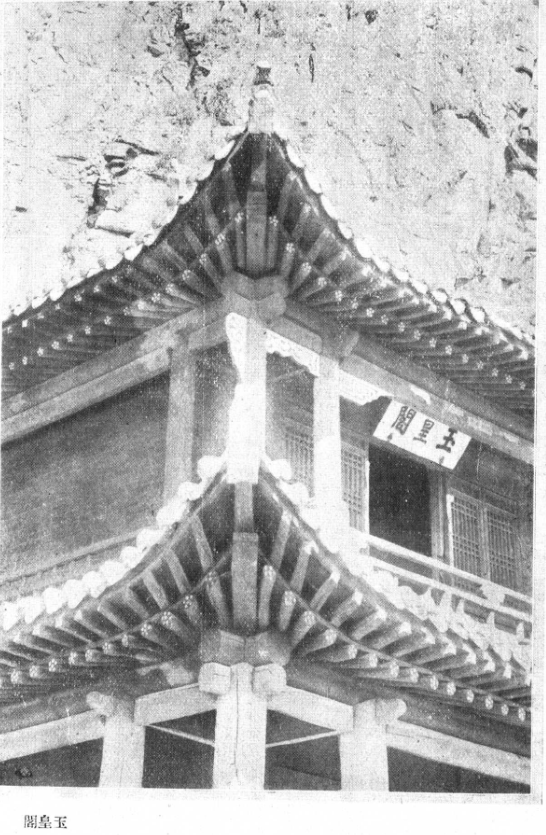
Yuhuang Pavilion
Original illustration from "Hengshan Mountain Travelogue"
From here, I descended to the Yuhuang Pavilion, which houses a statue of the Jade Emperor. To its left is Xiyang Rock, with the inscription “Sunset Glow.” The rock is quite high, the highest in the mountain. When the sun sets, its light reflects on the rock, hence the name. On the pavilion wall is a poem on Hengshan Mountain by Wang Yu of Tianzhong: "The great and flourishing one establishes the foundation of Shuofang, I inspect the place and visit the Xuanhuang. I come across auspicious air and morning mist, and climb to the peak to overlook the sunset; The wood in the Cui Xue Pavilion is old, and the water in the Zi Zhi Valley is fragrant. The scenery here is refreshing, and I enjoy the clouds and mist all day long." Another poem: "The crimson cliffs carve out beautiful lotuses, the rock walls are dark green and lush. I observe the flying stone caves in front of the temple, and stand on the pavilion on the top of the mountain; The pines and cypresses seem to be coiled cranes, and I hear the spring in the cave, afraid of disturbing the dragon. The spiritual cave stores thousands of liters of white clouds, and suddenly swallows up thousands of mountains."
East of the pavilion is the Huan Yuan Cave, with the inscription “Returning to Heaven’s Cleverness.” The Taoist priest said that there was once a hermit who entered the cave to cultivate his mind and did not come out for many years, then ascended to heaven from here. The cave is dark and bottomless. I lit a match, but could only see a few feet. It is a pity that I did not bring candles; otherwise, I would have explored it thoroughly. Next to the cave is the Tianyi Treasure Hall, and north of the hall is the Feishi Cave. The pavilions, halls, and temples here are exquisitely constructed and well connected. South of this is Yide Peak, with a pavilion at the foot of the peak inscribed “Embracing the Vastness.” Above the pavilion is a cliff with the inscription “Towering Green and Crimson.” There are countless other stone carvings, which I could not record.
Turning back from the pavilion, I passed Jietianqu and arrived at the Qinqi Terrace, where immortals were said to have played chess in the past. Later generations built this terrace, with stone chess pieces and a stone board. Feng Minchang of Guangdong wrote a poem about the moon: "On the Mid-Autumn Festival, the clouds are clear and the moon is bright, I watch the Yue Peak Terrace all night. It is not a jade palace, but the highest cold place in the world."
From here, I went west to the west peak of the mountain, where there is a pavilion called “Cui Xue Pavilion.” Looking down at the peaks below, they are like a white robe, with ancient pines, hence the name Cui Xue. The streets of Hunyuan County are clearly visible. After a long view, I turned back for lunch.
My trip to Mount Hengshan can be considered complete. Monk Kaicheng returned to Mount Wutai by the original route, accompanied by the people he hired there. I was going to visit the Yanmen Pass, so I went to Hunyuan and we parted ways. To meet a fellow villager thousands of miles away and travel hundreds of miles together, it must be fate. Parting is always sad. I don't know when we will meet again. We said our goodbyes and I thanked the Taoist priest before descending the mountain.
The Taoist priest asked a young Taoist to carry my luggage and guide me to Hunyuan. I asked which way to go down. He said that if I went down from the front of the mountain, it would be twenty li longer, and if I went down from the back, it would be twenty li shorter, but the back of the mountain had deep snow and was difficult to walk. I chose to go down from the back of the mountain. Leaving the temple, I walked along the mountainside, detouring to the west mountain head, and slowly descended. The path was like a sheer cliff, less than a foot wide, with three or four feet of snow. If I was not careful, my feet would sink in. Fortunately, there were footprints, so the path was still discernible. The boy carrying my luggage walked easily and quickly, showing his experience in mountain travel. There were ditches on both sides of the road, some built of stone and some of earth, said to have been built by the Feng army.
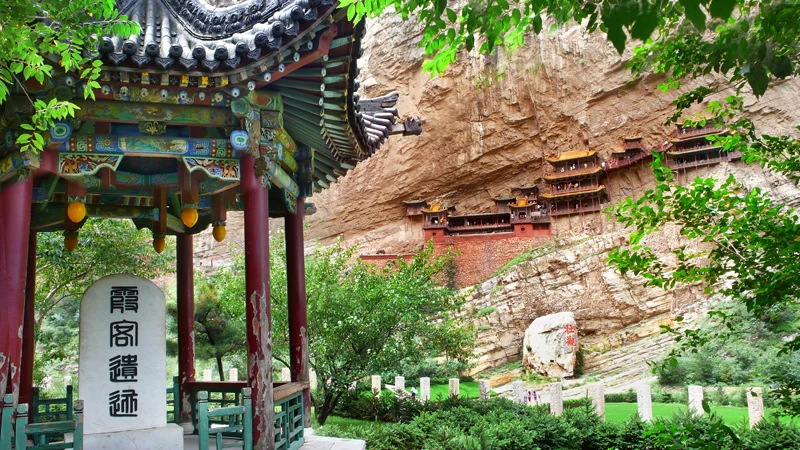
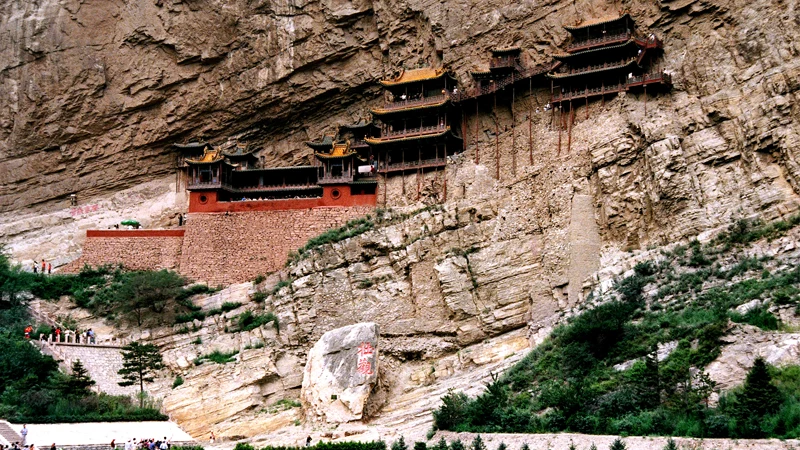
At the foot of the mountain, I detoured to the Hanging Temple, located on a cliff of Mount Hengshan, supported by many wooden beams, as if suspended in the air, hence the name. From the temple, I turned towards Hunyuan. Looking back at Mount Heng, it stood alone and majestic. The pines and cypresses in the mountain were as small as fingers, covered with snow. Its magnificent appearance needs no further description.
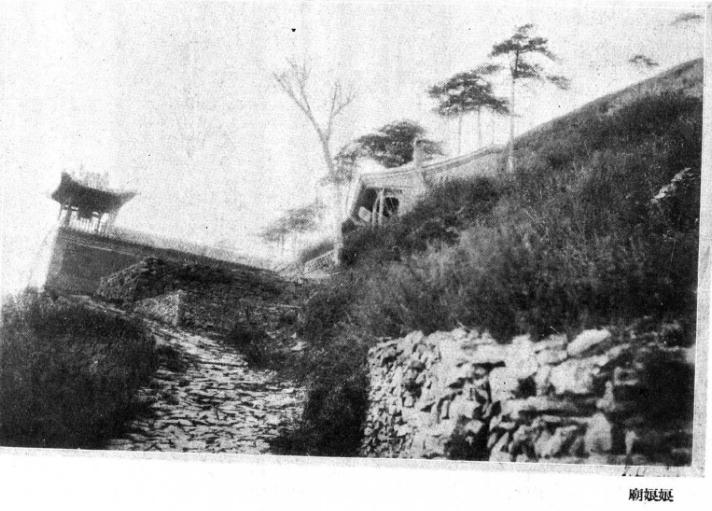
Niangniang Temple
Original illustration from "Hengshan Mountain Travelogue"
At 4 pm, arrived in Hunyuan. Entered the city through the south gate and stayed at the Taishan Niangniang Temple. During the night, a Taoist priest told me that the war had been going on for many days, the city's coal supply had run out, and people were using their tables and chairs as fuel. Those who had run out of tables and chairs were using the wall panels, and if the situation wasn't resolved, they would start dismantling houses for fuel. I asked him why so much fuel was needed and where the food came from. He replied that the weather was extremely cold, hence the high fuel consumption, but the city still had food reserves, so starvation wasn't a concern. He estimated that the Feng army's artillery fire into the city had been largely ineffective, with few shells exploding on impact, resulting in only a dozen or so casualties. He considered this divine intervention.
November 1st
In the morning, I went to the county government office for a brief discussion. I visited the Hunyuan County Middle School, located outside the east gate of the city. The school buildings were quite large, but unfortunately, they had been defiled by the military. There were over a hundred students, who were practicing military drills at the time and still seemed spirited.
Entering the city from the school, I saw a boot cage hanging inside the city gate, containing satin boots. I asked someone what it was for, and they explained that for officials who served with integrity and honesty, those seeing them off would remove their boots and hang them inside the city gate as a memento. The gate where an official left office determined where the boots were hung.
I visited the girls' school in the city, and I still saw some girls with bound feet. However, the small feet here were different; they were naturally small and slender, and the way they walked was graceful, unlike the small feet in the south. The girls' hair was shiny without being oily. There were other unique features, which are referred to as the "Northern Land Rouge Datong Women" (Hunyuan belongs to Datong, and is only 60-70 li from Datong).
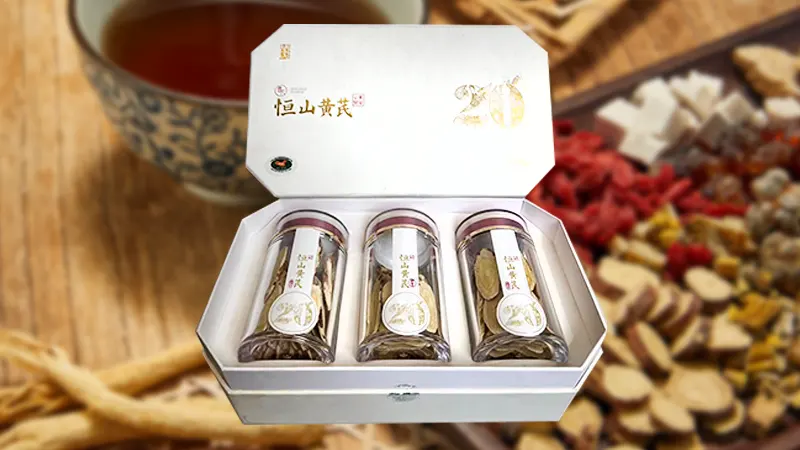
Leaving the girls' school, I went to a pharmacy and bought more than ten kilograms of Astragalus, intending to use it as a gift when I return south.
In the afternoon, I went to the police station to ask them to hire a mule for me. From here west to Yanmen Pass, the road is flat and suitable for riding a mule. I went to the police station's reception room to ask them to hire a mule. They immediately sent a police officer to do so, and soon a mule driver arrived. We agreed to leave the next day at 8 am, after which I returned to my lodgings.
November 2nd
The sky was overcast, with patches of dark clouds, suggesting the possibility of snow. The mule I hired didn't arrive on time, so I went to the police station to inquire. After 10 am, the mule driver came and asked where I was going, saying that he had been waiting for me at my lodgings for a long time. Hearing this, I couldn't help but laugh, as it was a case of mutual misunderstanding.
I returned to my lodgings, packed my things, left the city, and headed west. After about three li, heavy snow began to fall, making it impossible to see more than a few feet ahead. I told the mule driver that we should find a village to take shelter in. He said that the nearest village was twenty li away, suggesting we turn back. I agreed and went to the Sanyi Shop outside the south of my lodgings.
November 3rd
I woke up in the morning to clear skies and a foot of snow. The mule driver arrived while I was having breakfast. I left the shop, mounted the mule, and headed west. After traveling forty li, we arrived at Xifangcheng. At lunchtime, I saw children eating watermelon, which surprised me. There's a local saying: "Outside Yanmen Pass, in the wild homes, they wear fur in the morning and silk in the afternoon; and there's another strange thing, eating watermelon in October in the depths of winter." It's simply a matter of habit.
Continuing westward, I saw many holes in the ground. Suddenly, I saw three or four rats running around. The locals called them "field mice." They have sharp claws, dig burrows with many branches, making them difficult for people to catch.
After traveling twenty li, we stayed overnight in Xiaoxin Village.
November 4th
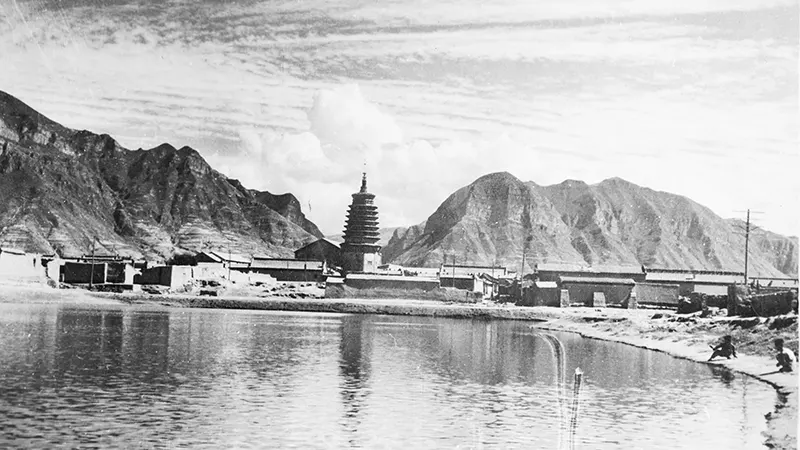
I woke up in the morning to clear skies. In the distance, I saw a range of green mountains covered in snow. Looking west, I saw a pagoda spire towering into the sky. Thirty li further, we reached Yingxian County, and the pagoda was the Dabao Pagoda in Yingxian County. The pagoda is 36 zhang high, with 30 large pillars around it, divided into nine stories. The top is a large iron pot with a large iron pillar passing through it. The pagoda is almost completely covered with plaques and couplets left by visitors. Every evening, when the sun sets, flocks of geese fly around the pagoda and call, and at night they roost on top. The locals say, "The lion of Jiangzhou and the pagoda of Yingxian, the great Bodhisattva of Dingzhou," highlighting the size of the pagoda.
Passing Yingxian and heading south for sixty li, we arrived at Shanyin County. Outside the east gate of the city, there were many new graves, and I heard a woman wailing for her husband. The couple had been married for not long when the husband went to the border, and he died in this war. Upon hearing the news, the woman dressed in white mourning clothes and went to his grave to mourn, her cries so heart-wrenching that it was unbearable to listen to. But how many others died in this war? I wonder if those in her family, or those by the Yongding River, know this? Alas, in the world, nothing is more painful than a young woman becoming a widow. May this war end soon.
Entering the city, I found that it had only one or two hundred households and more than twenty shops. The government office was quite small, the city walls were damaged, and one could pass through them. The traces of the shelling were everywhere on the city walls, especially at the west gate.
Passing Shanyin and heading west for about ten li, we rested in Jiancun.
November 5th
The rooster crowed at dawn, and as the first light appeared, I got dressed and set off westward. In the distance, I saw the walls of Yanmen Pass, built along the mountain ridge, rising and falling with the mountains, like a long serpent.
At 10 am, we arrived at Guangwu Town, north of the pass. It had a large population, about a thousand households, nestled at the foot of the mountain, with many shops, as it was an important transportation hub in the province. From here to the pass, there were more than twenty li, all through mountain streams and valleys. The two mountains were like sheer cliffs, with a road running through them. The entrance was seventy or eighty zhang wide, but narrowed to only one or two zhang at the pass. This is what is meant by "One man guards the pass, ten thousand cannot open it."
We arrived at the top of the mountain, where there is a Guan Di Temple. The road into the pass was like a woven cloth. The pass was double-layered, the northern one being the first, with the words "Yanmen Pass" inscribed on it, said to be written by Wang Xizhi. There is a legend that when he was asked to write these three characters, he refused. Another person then mixed these three characters with other characters on another piece of paper and asked him to write them. Wang Xizhi wrote halfway before realizing that the characters included "Yanmen Pass," but the character for "Pass" was not yet written. The person was at a loss, so he took it back and added a "silk" thread to the character "Gate," and carved it. But looking at it, the "silk" thread in the character "Yanmen Pass" is not very clear. Upon examination, it is indeed there, but why? It is unknown.
Entering the first pass, there is a temple dedicated to Yang Ye of the Song Dynasty, with a statue of Yang Ye inside. Entering the second pass, there is a temple dedicated to the Zhenliang General, with a statue of Li Mu inside. The temple has many plaques and couplets, many of which are excellent. In front of the temple, there is a stone pillar as a flagpole, erected on a high platform overlooking the pass road. On both sides are restaurants, where we had lunch. After this, we were considered to have entered the pass.
On both ends of the pass, the road is like a sheer cliff. Those traveling by carriage or on foot find it quite difficult. When ascending by carriage, one can only travel ten or so steps before needing a rest; during the rest, it is impossible to avoid propping the carriage wheel with stones. When descending, the carriage wheels must be braced by large stones at their edges to control their speed. For us pedestrians, we could not help but sweat and gasp for breath.
After lunch, I rode my mule south, passing through a mountain village. There was a monument commemorating someone's tiger hunt, whose name I have forgotten. Beside the village, a stream gently flowed, and wild birds flew. After twenty li, I reached the foothills. They were mostly earthen hills; Daizhou was in sight.
After traveling about ten more li past Daizhou, I stayed overnight in a western village.
November 6th
I woke up in the morning. During the night, I was disturbed by another person in the room. This person was a servant at the inn, who smoked opium at night; the smell was quite unbearable. We had traveled a long way and were finally ready for a good sleep, but this stimulation prevented us from sleeping. The strict opium prohibition in Shanxi Province surpasses other provinces. Unexpectedly, there are still people consuming it in the countryside. Looking at the person's condition, they appeared poor and pitiful. I wondered where they could find the money to buy opium.
After breakfast, I mounted my mule and headed south. I passed several large towns, and arrived at Xinzhou at 3 pm.
Entering the city, I went to Mr. Yao's place at Xinzhou Middle School; we were very happy to see each other. I asked if a certain military officer had sent over a bicycle, and he said that the officer had come once before, claiming to be urgently heading to the province, and had already taken it to the provincial capital. Regrettably, tomorrow I will only have the option of returning to the province by rickshaw and staying at the Yisheng Inn outside of the city.
November 7th
I got up at dawn. A few sparse stars were visible, and the cool air was chilling. I wrapped myself completely in a wolfskin blanket and cotton quilt for fear of catching a cold. After traveling twenty li, the sky began to brighten; the multicolored light of the sleet, the rising sun like vermilion, and the surrounding cold mountains, with their elegant colors, were all beautiful.
At 8 o'clock, I passed Shi Ling Pass. From here south, the road became somewhat flatter.
At 3 pm, I passed the airfield, and arrived at the provincial capital at 4 pm. I rested at the school; my colleagues all looked at me with admiration, which I truly did not deserve.
This is recorded for posterity.
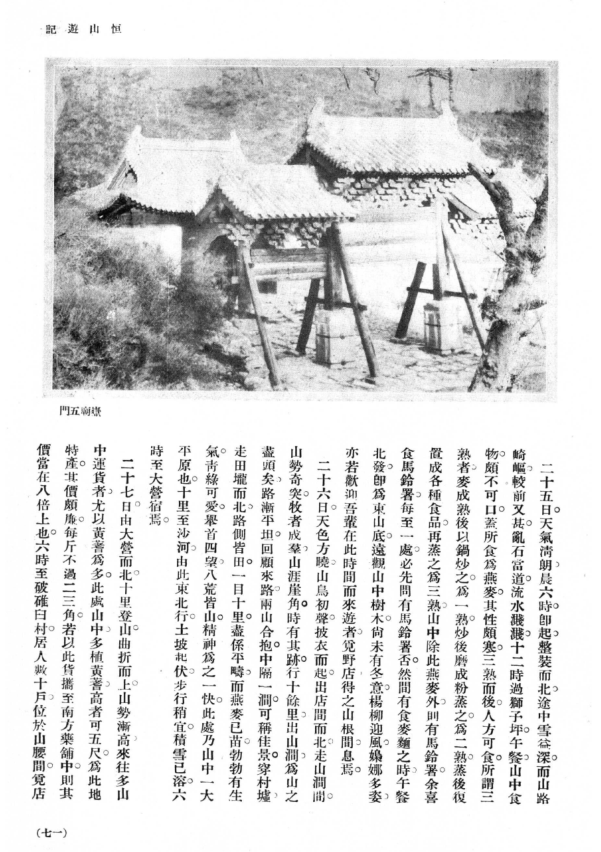
Inside page of "Hengshan Mountain Travelogue"
Originally published in "Travel Magazine," Volume 1, Winter Issue, 1927
Introduction to "Travel Magazine"
"Travel Magazine" was a renowned domestic travel publication during the Republic of China period. In order to prevent the disappearance of past lives, to better remember today's life, and for a better tomorrow, in addition to collective memory through oral transmission, written records are the best way.
In the Spring of 1927, the China Travel Agency launched the quarterly "Travel Magazine." The editorial office was located on the fourth floor at 110 Renji Road, Shanghai (China Travel Agency, Sichuan Road, Shanghai). Zhuang Zhujiu was the general manager, and Zhao Junhao, an editor for the "Shenbao," was appointed as the chief editor. Zhang Zhenyu, a painter, was in charge of the art section. There were 4 issues per year, making one volume, priced at 3 jiao per issue, and 3 yuan per year. Beginning with the third volume in 1929, "Travel Magazine" changed to a monthly publication, lasting until December 1942, comprising a total of 16 volumes.
"Travel Magazine"'s content was extremely rich and varied, and could be divided into four categories: travel experiences, travelogues, travel notes, impressions, and records of investigations; discourses on banking, transportation, and economics; academic studies exploring ethnic groups, culture, and social life; and literary works, such as poetry, novels, and other writings and illustrations.
The aim of "Travel Magazine" is to describe the landscapes and local customs of China and other countries; its nature is that of a high-level publication for a general audience. Comments on "Travel Magazine": The creation of a magazine on travel started with this agency; thus, after its publication, it became popular across the country. The articles in each issue are extremely beautiful; the magazine uses printed photos to supplement the limitations of textual descriptions. This is a book for readers that is, in essence, a complete view of the landscapes in various places. Even those who lack a travel spirit will, upon seeing it, feel the desire to wander. Moreover, the printing is excellent, using high-quality Swedish paper. The editing and art, the neat use of Chinese characters, and the landscape illustrations at the beginning of the volume add significantly to its value.
Proofreading: Xue Fang
Editor: Xing Xuelin
Author's Introduction
Wu Shaocheng, a native of Jiangsu Province, his life details are unknown. He once lived in Shanxi, and in 1926, he worked at a school in Taiyuan. This article was written in the autumn of 1926, and originally appeared in the Winter Issue of Volume 1, 1927, of "Travel Magazine."
Keywords:
Hengshan
Related News
Contact Us
Beiyue Hengshan Scenic Area:
Travel Inquiry:+86-352-8333077
Ticket Inquiry:+86-352-8333031
Travel Complaints:+86-352-8333081
Emergency Rescue:+86-352-8333037
Scenic Area Product After-Sales Service Hotline:
+86-18636203837
+86-15383522518
Mount Hengshan Scenic Area Administration Center (Official)
+86-352-8322142
Hanging Temple
+86-352-8327795
Yuemenwan (Hengshan Mountain Gate)
+86-352-8480060 +86-352-8328318 +86-352-8328530
Hengzong
+86-352-8480115
Tianfeng Ridge
+86-352-8480114
Yong'an Temple
+86-352-8322390
Li's Family Cemetery
+86-352-8322381
Hengshan Cableway
+86-352-8322255
Official Media

Tiktok