

-
AboutMount Heng, an outstanding representative of the splendid mountains and rivers of China, a symbol of national prosperity, a totem of national spirit, an important geographical indication of the country, and holds the status of a national mountain.More
-
CultureHengshan has been a famous scenic spot and important birthplace of Taoism in northern China since ancient times. Carrying the symbols of Chinese civilization, it has nurtured profound regional culture and folk customs.More
-
-
Tourist GuideUnderstand relevant information about the scenic area and enjoy a better travel experience.More
-
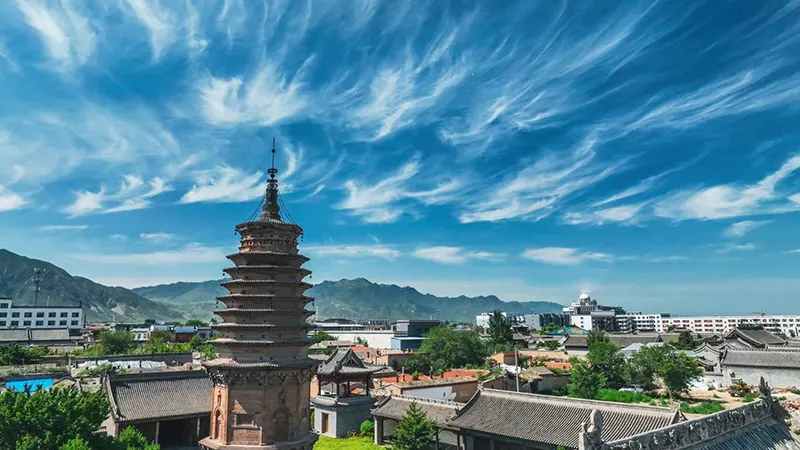
Surrounding activitiesThe ancient city of Hunyuan at the foot of Mount Heng in Beiyue has a long history, rich cultural heritage, beautiful scenery, and a convergence of agriculture, commerce, and animal husbandry. It has nurtured a unique regional culture and is renowned for its fine wine and delicious food.More







Jiang Shunan of the Republic of China | Hengshan Mountain Travelogue (1920)
Publish Time:
2025-12-08 11:30
Source:
Jiang Shunan (1885–1934), from Yueqing, Zhejiang, was a key developer of Mount Yandang. Liang Qichao referred to him as “ Xu Xiake, Part Two ”, “Travel Magazine” calls it “ China's First Modern Traveler “He is agile and nimble, with a deep passion for travel. Whenever he explores a new place, he meticulously records the topography of each mountain. More than simply broadening his knowledge, he places great emphasis on cultivating his character through these journeys. His writing is straightforward and unadorned; since much of his writing is done between two and three in the morning—when his mind is particularly clear—he ensures that every single word is truthful and fully expressive.”
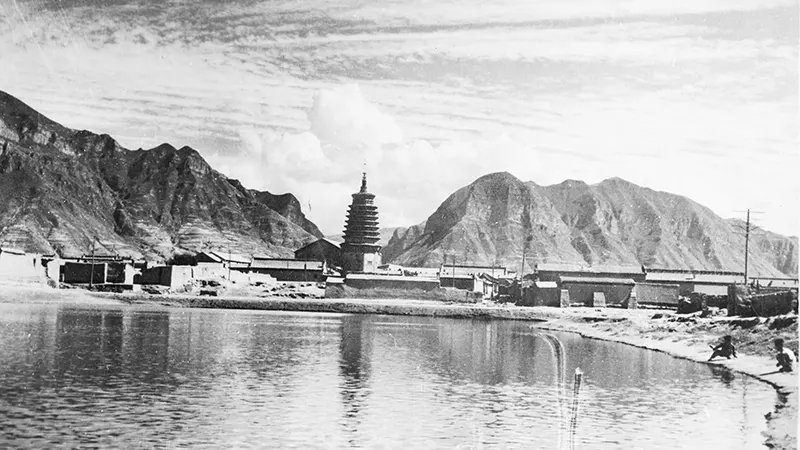
On March 17, 1920 (lunar calendar), Jiang Shunan, accompanied by his old friend Liang Shanji (whose courtesy name was Boqiang and who was a veteran member of the constitutionalist faction in Shanxi Province), set out from Beiping for Datong to visit the magnificent sculptures at the Yungang Grottoes in Wuzhou Mountain. Early on the 20th, Mr. Liang returned to Beiping. Jiang Shunan, however, rode off on horseback toward Hunyuan to explore Hengshan Mountain, the "Northern Yue." After spending two days there, he returned to Beiping from Datong on the 23rd. The travelogue titled "Hengshan Mountain Journey," which he wrote during this trip, was first serialized in the fourth section of that year's "Shishi Xinbao," running daily from July 30 to August 4, with one installment per day, for a total of six installments. The following year (1921), Jiang Shunan compiled his travelogues—including "Hengshan Mountain Journey"—into a book titled "Jiang Shunan's Travelogues, Volume One." The book featured prefaces by Liang Qichao and Zhuang Yunkuan and was published and distributed by Fuxing Printing House (Shanghai). It is worth noting that the version of "Hengshan Mountain Journey" published in 1921 had been slightly revised compared to the original manuscript first published in 1920.
Travelogues by modern figures exploring Hunyuan and Hengshan Mountain have always been a key focus of this publication. This article is a rare and excellent piece, and we are pleased to publish it here for our readers. To respect the author's original intent, we have used the revised version from 1921; we would like to make this clarification accordingly.
Editor's Note

▲ Preface by Liang Qichao to “Jiang Shunan’s Travelogue, Volume One,” Tenth Year of the Republic of China
"Jiang Shunan's Travelogue" was a bedside book during Chiang Kai-shek's military career and the earliest work through which Chiang came to know Hengshan Mountain.
Hengshan Mountain Travelogue
The Fourth Page of the "Shishi Xinbao"
July 30 – August 4, 1920
Hengshan Mountain Travelogue
Written by Jiang Shunan
Yesterday, after visiting the Yungang Grottoes, we stayed overnight at Zhenhua Company. The next day, we toured the coal mine of the Baojin Branch Office along the designated route and returned to Datong on horseback. It was the 19th day. (March 1920, lunar calendar) It's already too late.
March 20th
I got up at five in the morning, and Mr. Boqiang① took a bus back to Beijing.
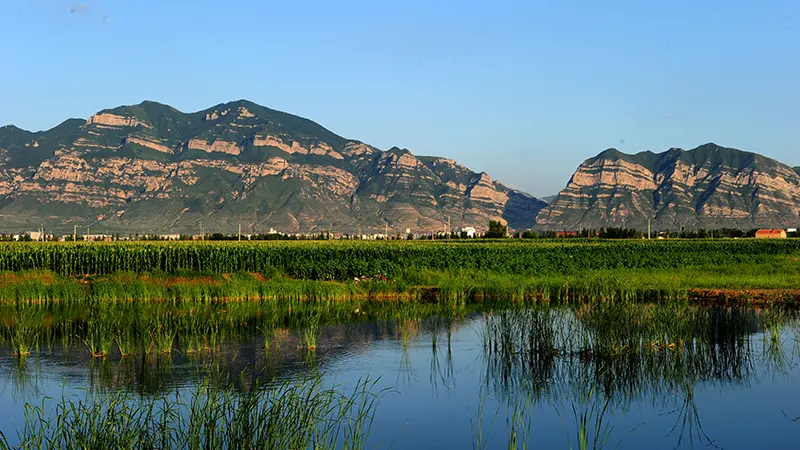
Commander Zhang Hanjie of Datong Town② ordered the gendarmerie to prepare horses, so I immediately mounted one. At 6:60, I rode out through the South Gate of Datong, heading southeast. Within less than ten li, I crossed the Yu River—also known as the Imperial River, but commonly called the East Ten-Li River. Next came Wuli Si’er Village, Bili Xiaonan Village, Wuli Aijiazhuang, and Wuli Shangquan Village. About a li west of the villages, the Wuzhou River joins the East Ten-Li River here. Then came Shili Zhoujiabao and Wuli Luozhenying Village. In the village, there’s the Datong Third District Police Substation; I took a brief rest here and had a light lunch. Five li further lay Liren Zao, and three li beyond that, I crossed the Sanggan River. The riverbed is about two li wide, and the water isn’t very deep, yet it’s extremely muddy. Local residents guide horses across the river here; in deeper sections, the water reaches up to the horse’s belly. After crossing the river, I passed Jijiazhuang and then climbed uphill for six li until I reached the entrance to the Wengcheng Pass. From the Wengcheng Pass, I headed south into a valley that winds its way deeply and intricately, dotted with bizarre rock formations. The path here is narrow enough for only one rider at a time, and it’s called Wangcunyu. (The homophone of Wengchengyu) The ice in the valley was exceptionally thick; we rode over the shattered ice to drink, and the cold seeped right into our hearts and lungs. On either side of the valley, two mountains rose high and sharply carved—known as Matou Mountain. Every twenty li or so, we’d climb another ridge, until we reached Songshuwan and entered the territory of Hunyuan County. Despite its name, Songshuwan had no pine trees at all—it was actually just a hilltop, the very summit of the ridge. Why then was it called “Wan”? To the southeast, a pair of peaks stood proudly, about fifty li away—this was Hengshan Mountain. I named this ridge “ Wang Heng “…which seems more fitting than Songshuwan. Ten li down the hill lies Nigou, and ten li further on is Baiyuliang.” (A homophone for Beiyu Lin) Ten-mile交接 Gou (The homophone of Jiangjiagou) Shiqiao Fort, fifteen li away (The homophone of Tuqiaopu) Qili Hunyuan County Town. Entering from the West Gate and proceeding to the East Gate, I checked into a lodging at... Deju Cheng Grain Store It’s 7:30 p.m.
The inn in Hunyuan was so filthy and unhygienic that it was simply uninhabitable. The grain store, on the other hand, was an ordinary shop that also provided lodging for travelers. There were three or four such stores within the city, and this one was the largest. Yet inside a single room, more than ten people slept directly on large earthen pits, with burning coal still smoldering in the pits to keep them warm. Unaccustomed to such conditions, we found it extremely difficult to feel comfortable there. When the gendarmes informed the shopkeeper, he promptly had the east wing—where cluttered items had been stored—cleaned out and prepared for our use. He even removed the felt mattresses and other belongings we’d brought from horseback, arranging everything neatly for our rest. Moreover, he brought along a small table and a chair, treating us with the utmost kindness and consideration.
Today the sky is overcast with no wind, making for excellent walking conditions. However, along the route, there are very few places to rest, and it’s also quite rare to come across forests. The newly planted forests are currently being established—this clearly demonstrates Shanxi’s military governor and provincial governor, Yan Xishan’s, commitment to a tree-planting policy.
Along the way, we passed through villages where walls and utility poles were covered with large signs bearing the 34 articles of admonishment issued by Governor Yan Xishan of Shanxi, as indicated by the markings. Faithful, Loyal to the Group, and Ambitious The six-character ideology is the most common. In addition, many characters—some as large as a斗 (dou)—are found painted on mud walls, known as “Large Vehicle and Horse Inn” “Small Shop That Keeps Guests” Then there’s the shop sign of the inn; some also write beneath it. “Rice and noodles are fully stocked, and tea is readily available.” Moreover, there is also a book. “Those who come will have smooth progress; those who leave will become prosperous.” The phrase “deng yu” carries the implication of advertising or solicitation. There is also a book containing five-character poems, which reads: “At this major crossroads, gentlemen from all directions come and go. Inside the gate lies an inn, where tea and water are readily available.” This kind of advertisement— I know that today’s new poets, upon seeing it, will surely quickly identify with it as kindred spirit.
The men and women one sees mostly wear a peculiar type of half-sleeved garment that covers only the abdomen and shoulders. Women expose their arms and breasts; their barbarity is no less than that of foot-binding. Yan Xishan’s... The Six Major Policies Why don't we discuss it?
Datong is said to be 140 li or 120 li from Hunyuan—actually, the distance I traveled was a little over 130 li. By car, the journey takes either two days or a day and a half, and it involves passing through Wangcunyu. (The homophone of Wengchengyu) The journey was extremely bumpy. I reached my destination on horseback in a single day and felt quite pleased with myself. For dinner that night, I ate fried soybean noodles and...
Stir-fried spinach. Hunyuan spinach is exceptionally tender and lush; vegetable gardens around Xiguanwai all cultivate it, and the price is only five wen per jin. In Hunyuan, each "diao" of currency is equivalent to 330 real wen, and each "baihe" amounts to 33 wen—this is a special monetary system. Hunyuan produces liquor, second only to Fenjiu. After drinking four liang of liquor, I went to bed.
Note:
① Mr. Boqiang: Liang Shanji (1862–1925), courtesy name Boqiang, was from Guo County in Shanxi Province. He passed the imperial examination during the Guangxu reign of the Qing dynasty and served as a Shujishi in the Hanlin Academy. He later became the chairman of the Shanxi Provincial Advisory Council. In the early years of the Republic of China, he held various positions including president of the Shanxi Education Association, member of the National Assembly, vice minister of Education, and director of China University. He was also a leading figure in the Republican Research Group.
② Mr. Zhang Hanjie: Zhang Shuzhi (1881–1946), courtesy name Hanjie, was from Guo County in Shanxi Province. A member of the Tongmenghui, he participated in the Xinhai Revolution uprising in Shanxi. He held the rank of Lieutenant General in the Army and served as the Garrison Commander of Northern Shanxi at the time, stationed in Datong.
March 21st
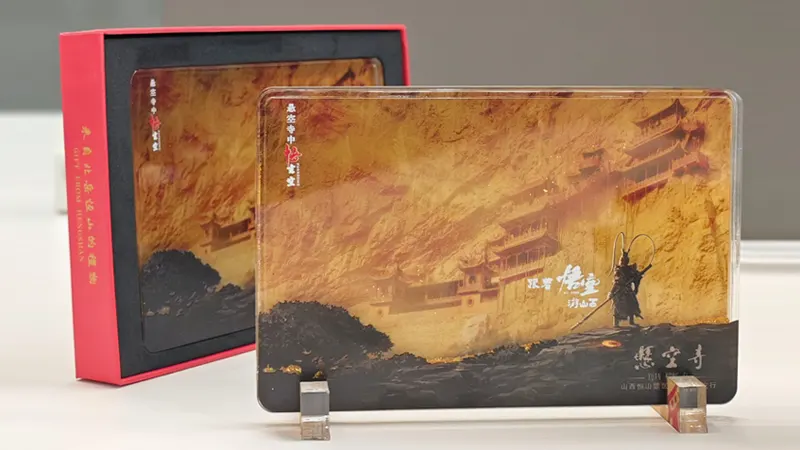
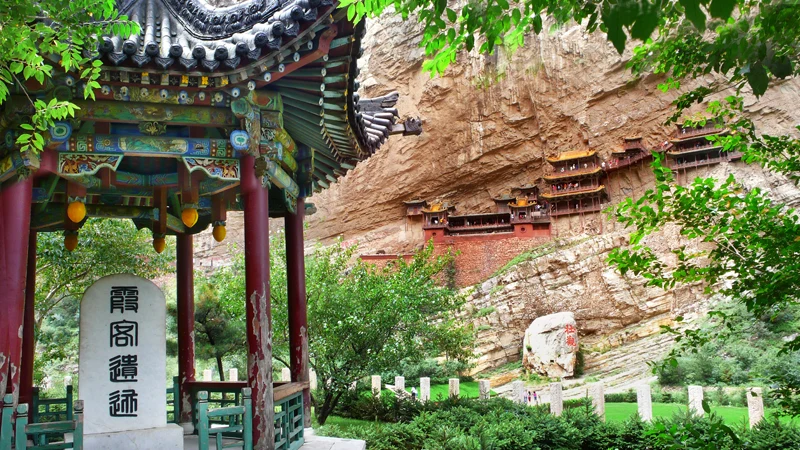
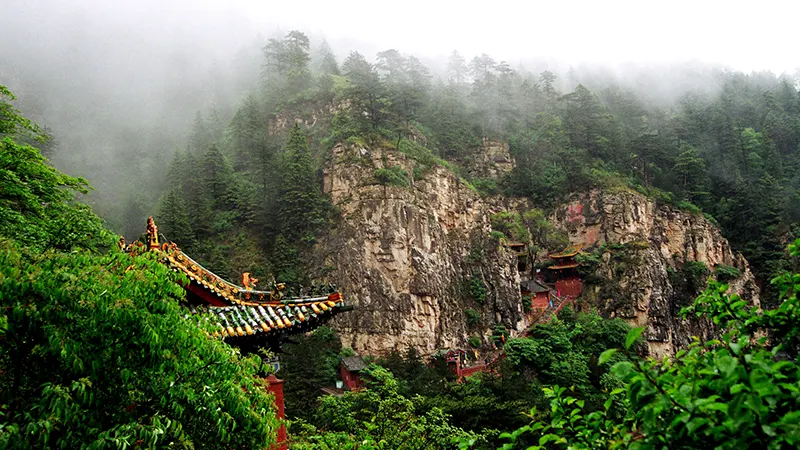
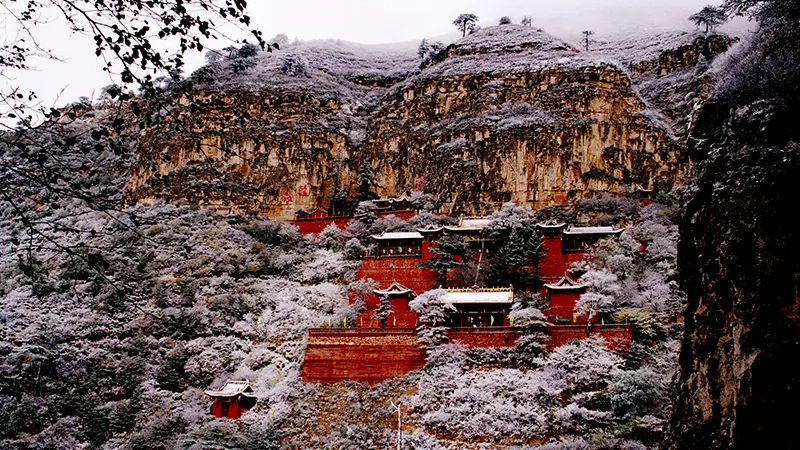
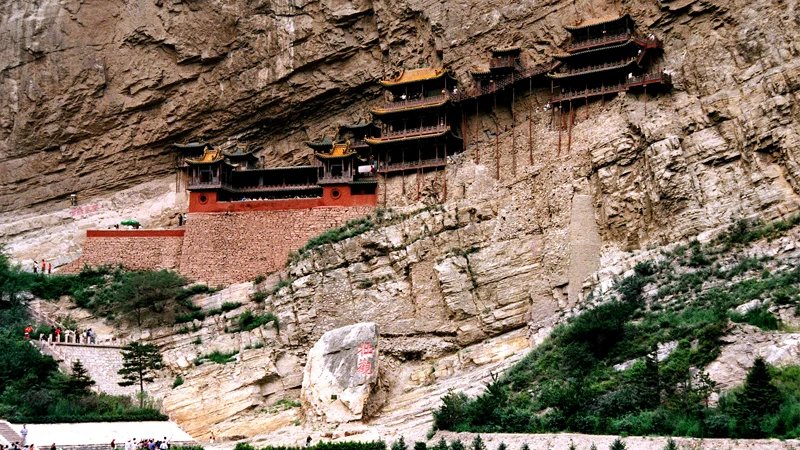
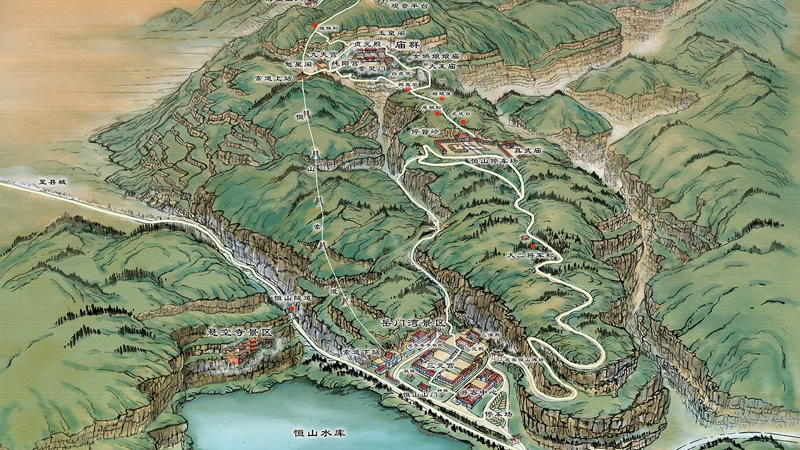
At six o'clock, we mounted our horses and exited through the south gate of Hunyuan. The county town of Hunyuan sits at the foot of the western slope of Hengshan Mountain. From the west side of the mountain, there’s a path that leads upward—relatively close. However, if you wish to admire the beauty of Jinlongkou and the Hanging Monastery, you’ll have to head southeast. After leaving the city and traveling about twelve li, the road became extremely rough, consisting entirely of rocky beaches. The larger stones were fist-sized, while the smaller ones resembled peaches, making it very difficult for the horses to proceed. I asked our guide about the condition of the road ahead, and he said it was always like this. So I dismounted my horse and instructed the gendarme to lead it back into the city for lodging. Then, armed with my walking stick, I continued on foot for five li until I reached Tangjiazhuang. (Tangjiazhuang, a pun) The two mountains, Zhuang and Nan, stand side by side, their slopes remarkably steep and majestic. On the cliff of Nan Mountain there is a cave housing a small pavilion, said to be the Temple of the Three Pure Ones. As you enter the valley, towering cliffs rise on either side, with a stream flowing through the middle. The path you’re taking is the main route connecting Hunyuan with Tongling and other counties—indeed, you walk right along the stream itself. Whenever the water becomes an obstacle, you simply leap across it. After walking several hundred paces, you’ll notice something on the left-hand cliff... Cui Ping Two-character inscriptions carved into the cliff face, written in the "Bafen" style. As we proceed another three or four turns, the stream becomes narrower and the cliffs loom ever higher. Seen from the side, they resemble peaks; viewed head-on, they appear as sheer walls—there’s simply too much to take in at once. After walking about a li, the cliff suddenly opens up, revealing five or six stories of pavilions perched atop it—the famous Hanging Temple. Climbing the steps to the temple, we find that it was extensively renovated during the Tongzhi era. According to the inscription on its stele, the exact origins of the Hanging Temple remain unknown, though remnants of an ancient stele still bear the reign title of the Jin Dynasty’s Dading period, suggesting that its history stretches back a long way indeed. The temple is built by chiseling pillars directly into the cliff face and using wooden beams inserted into these pillars. The central two-story building houses five main halls; the upper eastern section rises to three stories, with three divine statues enshrined there, and to the left lies the Pure Yang Palace. The western upper section consists of two more stories. Beyond this, passing through a cave and then rounding a bend, a flying bridge spans thirty feet above empty space below. Crossing the bridge leads to a five-story pavilion known as the Sun Palace. Leaning on the railing and looking down, one sees the rushing stream below, while across the gorge, the terraced cliffs of Dan Cliff rise in tiers—just as Xu Xiake described them. "Wuyi and Jiugu are not worthy of being compared to it." All inscriptions must be left on the temple walls:
I lean on my staff at the foot of Hengshan Mountain, following the stream as far as it leads.
Both mountains stand sheer and vertical, yet a temple suddenly hangs in midair.
Amidst the mist and rosy clouds of the Buddhist pavilion, the meditation hall seems ethereal and elusive.
Leaning on the railing, I sit idly for a long while, then ascend to the highest peak.
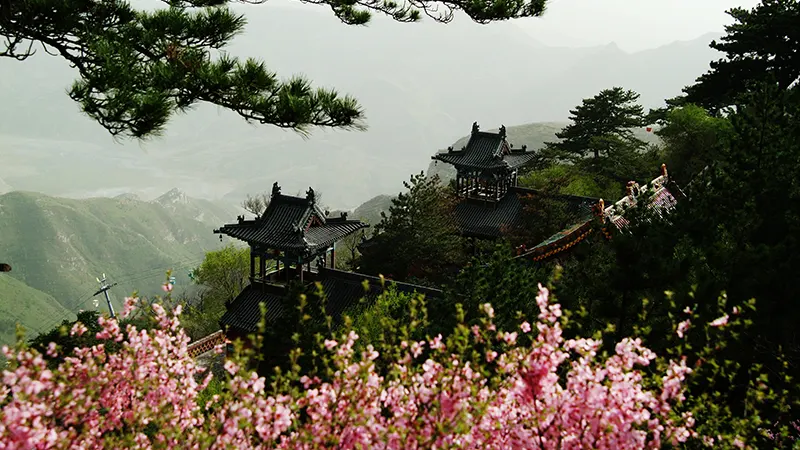
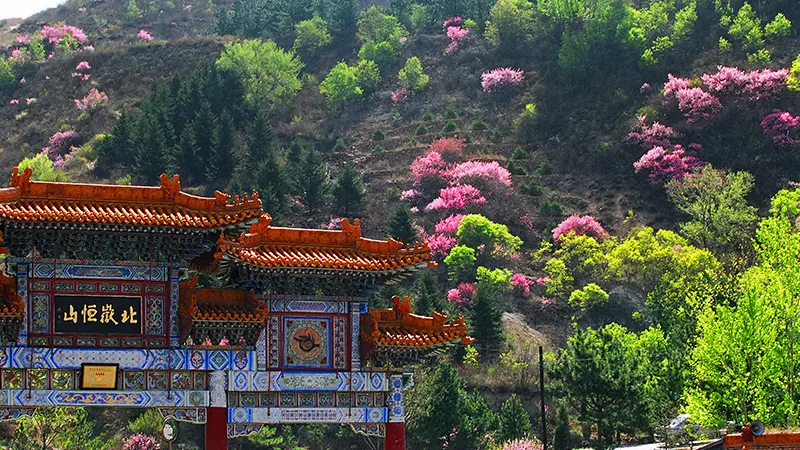
On the way to Xiashi Temple, I saw numerous large square holes chiseled into the walls on both sides. On the right wall was a large inscription carved into the cliff face, which read: Cloud Pavilion and Rainbow Bridge Superintendent Aigang Shu once carved holes and built bridges to help people cross the stream; now, he simply follows the stream’s course. It is said that every year during heavy floods, thousands of ravines and valleys suddenly surge forth, often submerging carriages and horses. By the stream’s bank, there is also a large... “Clear” The characters are carved into the cliff face; beneath the character “Qing” there remain additional characters. Indeed, back then, the high cliffs where these inscriptions were made once formed valleys, and deep valleys later became hills—mountains and rivers inevitably undergo such changes over time. As we continue further into the mountains, the terrain suddenly opens up. About two li ahead, we come across a cliff on the left bank of the stream, bearing an inscription that reads: Wang Zong , signature below Hong Yi Ji , and Cui Ping The same handwriting. Also, from Li Xu to Xia Ban Fort. (Anagram of "xia pan pu zhi") , turn west and head north, passing through Divine Skill, Next Generation The pavilion has 79 steps; another pavilion is called... "Defend Yan and Jin" All were recently repaired in the vicinity. In front of the archway sit two stone lions and two iron lions. To the left and right of the archway stand the newly restored steles of the Northern Yue Temple; there is also another stele titled— “The No. 1 Mountain in Northern China” Further ahead is the Red Gate, with an inlay above it. "Hengshan Mountain" This inscription was written during the Hongzhi period of the Ming Dynasty. From here, the path winds its way uphill for about five li, until you come upon three majestic pines standing on the left side of the trail. About another li further along, you pass through Tingzhi Ridge Village, where ancient pines on the eastern peak of the village remain lush and verdant. A little farther on, cliffs and rocks rise abruptly, bearing an inscribed stone carving. Hengzong Two characters, each about two zhang in size. Further inside, there’s a pavilion called... Tiger’s Mouth A stone inscription within the courtyard reads: Jie Shi , said Golden Dragon Mouth Is Jinlongkou located halfway up the mountain, rather than on the mountaintop?
Beneath the ancient pine tree behind the pavilion, the stone surface is remarkably flat and spacious. I sat down on the stone for a brief rest; the sound of the waves rustled softly, and a gentle breeze carried a fragrant aroma that almost lulled me to sleep. About another li further along, our guide pointed out that ahead, to the east, lay a cave. So we began to climb over thorny bushes to reach it. Less than half a li later, we came upon a cave—about twenty feet high but only a few feet deep, hardly worthy of being called a cave at all. Continuing along the cliff, we turned northeast for more than a hundred paces, then found a flight of stone steps leading upward. There, carved into the rock face, was an inscription that read: “Connecting to the Heavenly Avenue” , said “Thousands of rocks vie in beauty, and ten thousand valleys compete in charm.” The pavilion stands at the northern end, directly facing the Southern Gate of the Heng Temple. Behind the pavilion, there are numerous cliff inscriptions, some of which are legible. “Yide Peak” Three major characters and A Scenic Spot in the Clouds Four large characters are inscribed here. To the east of the pavilion, a rocky cliff curves around like a crescent moon, standing some forty zhang high, with its base arching inward to form a cave. On the left side of the cliff, beneath the overhanging rock face, lies a cave no more than four or five feet high—a cavern that plunges deeply into the earth, utterly dark and devoid of any visible light. It is called the “Huan Yuan Cave,” and was inscribed by Lou Yingkun, a scholar of the Ming dynasty. Huan Yuan Tian Qiao Cave The inscription roughly states that, according to a mountain hermit, the stone cave was once accessible to humans. It is said that in ancient times, those fleeing from the barbarian invaders hid here, only to be attacked by them; thus, the cave was sealed shut with stones. In front of the cave stands the main hall. To the right of the hall, a small platform has been constructed, upon which the “Record of the Ancient Beiyue Flying Stone Caves of Hunyuan,” composed by Lu Zhen, the prefect of Datong during the Ming dynasty, is erected. The following is an excerpt from the inscription:
In ancient times, Emperor Shun established his capital at Pusuan, founding twelve provinces and consecrating twelve mountains. Since Hengshan Mountain lay to the north of the capital, it was designated as the Northern Yue—today’s Hengshan Mountain in Hunyuan County. According to the old chronicles of Hunyuan: In the twelfth year of Shun’s reign, during his northern tour and hunt, he reached the Northern Yue and headed toward Mount Damao. But encountering a heavy snowfall, he found himself unable to proceed further through the icy ravines and valleys. Thus, he offered distant sacrifices to the mountain. Suddenly, a stone flew down gently before the emperor, known as the “Anwang Stone.” Five years later, during another tour and hunt, this stone again flew to Quyang, whereupon a temple was built to enshrine it. From the Three Dynasties onward, through the Qin, Han, Sui, and Tang periods, the Northern Yue was consistently worshipped at Hengshan Mountain in Hunyuan. During the Five Dynasties period, the region of Hebei was lost. When the Song dynasty came to power, the north fell under the control of the Khitans; later, the Bai Gou River became the boundary. The Song capital was moved to Bianliang, while Zhen Ding remained in the north. Consequently, the Northern Yue was worshiped at Quyang in Zhen Ding—a temporary expedient adopted at the time. The Ming dynasty continued this practice. In the Bingwu year of the Chenghua era, a district official named Zhen arrived in Datong to take up his post. Upon ascending Hengshan Mountain and paying respects at the temple, he saw that the temple had fallen into ruin and felt deeply saddened. He therefore, together with the county magistrate Dong Xi, petitioned the provincial governor, Lord Hou, requesting that the temple be renovated and many new halls and pavilions be rebuilt. As for the flying stone, there is a cave to its right. A Taoist priest was sent to Quyang to measure it; the stone was nine feet high, four feet wide, and one foot two inches thick—dimensions not significantly different from those of the cave itself. Thus, the inscription “Flying Stone Cave” was carved on the cave wall, marking its significance.
Yu's comment: Before the Ming dynasty, the location of the Northern Yue was universally believed to be Quyang. However, Quyang is situated in a plain—without any mountain to speak of, how could it possibly be called a "Yue"? Now, according to Lu's account, Quyang's designation as the Northern Yue is nothing less than a disgrace to China's territorial integrity. Although the record does not explicitly mention the imperial court sending officials to perform rituals at Hengshan Mountain, the fact that Hengshan Mountain was again honored with rituals during the Hongzhi era was indeed due to Lu's efforts.
Traveling northward from Feishikou, you’ll find Baiyun Cave above, with walls adorned with... “White Cloud Spirit Cave” A four-character inscription carved into the cliff face—after turning south for fewer than a hundred paces, you’ll enter the Heng Temple through the Chongling Gate. Inside the gate, to the left is the Qinglong Hall, and to the right is the Baihu Hall. The stone steps are over a zhang wide and consist of 104 steps in total; at the top of the steps, you’ll reach the main hall of the Heng Temple. The plaque above reads: The Hall of Zhenyuan The hall has four bays, and its architectural style is vastly different from that of the majestic Mount Song and Mount Tai. From the west side of the hall, it’s less than a hundred paces to the Hall of Immortal Assemblies. Built against the rock face, this hall houses numerous Buddhist statues. In front of the cliff stand four maple trees, each towering thirty feet high and extraordinarily lush and verdant. To the right of the temple is the Jade Emperor Pavilion, and further to the right still stands the Imperial Stele Pavilion. The two cliffs feature inscriptions carved into the rock face: “Famous Mountains Under Heaven” , said "Reaching Heaven from the Edge of the World" , said Grand View of Heaven and Earth , said Standing tall and steep as ten thousand fathoms. All of these are factual accounts. Continuing westward for several dozen steps, one climbs upward through a narrow crevice in the cliff face, ascending along the rocky slope. After about thirty zhang, one reaches a slightly flatter rock—known as... "Qin Qi Platform" Below is a cliff inscription named: Traces of Enlightenment 。
We rested at Heng Temple, cooked millet soup, and enjoyed it together with the pancakes we’d brought along. From the east side of the temple, we headed northward, ascending through the valley gorge for a little over two li until we reached the summit of Heng Mountain. Below our feet lay Hunyuan County’s octagonal-shaped town—much like the view from Songshan’s peak overlooking Dengfeng City. In the distance, the mist was exceptionally thick; our guide told us that on a clear day during Qingming Festival, one could even see Yingxian County’s town. On the west side of Heng Mountain’s summit, sheer cliffs and precipitous slopes loomed steeply, utterly unlike the gentler terrain to the southeast. A fierce gust of wind buffeted us, making it impossible to linger long. We turned back, passed by Heng Temple once more, and descended to Li Quan Pavilion. The pavilion covers a well whose water is remarkably clear. As we drew some water to drink, the coldness sent shivers down our spines, even causing our teeth to chatter. From here, we set out again. Forever establish in Ji Province The path leads past Chunyang Palace, Lingyun Pavilion, and Yuhuang Pavilion, then continues westward to Kui Xing Pavilion. From the pavilion, the trail descends into the steep, rocky ravine below—so steep that it’s impossible to place one’s feet securely. The slope is utterly precipitous; a single slip could send you hurtling down into the valley floor. For this reason, very few travelers ever make it this far. After about four li, we came upon a thick layer of ice at the bottom of the ravine. We scooped up some of it to drink, then paused briefly on a large rock for a rest. From there, the trail veers northward, eventually leading to the Temple of the White Dragon King. Just then, a woodcutter poked his head out from among the thorny bushes, asking us where we’d come from and how far the Heng Temple was from here. It was clear that few people ever made their way this far. Continuing downward for another four li or so, we reached a dirt slope and emerged into Tangjia Village. (Tangjiazhuang, a pun) Two li north—just about two li from the southern gate of Hunyuan. Returning to Liangdian, it was already nearing five o’clock.
March 22nd
I got up at four in the morning and asked the shop assistant to prepare a meal for me. The total cost—including room rent, horse feed, and food and drink—came to five hundred and twenty cash coins, plus an additional over sixteen hundred cash coins in actual money, which amounted to just over one dollar in silver, with some change left over. Although the food wasn't particularly delicious, the price was remarkably low.
At five forty, I mounted my horse and headed westward. At twelve o’clock, I reached the entrance to the Wengcheng Gate and made camp there. Once we crossed the Sanggan River, the road gradually became smoother, and I urged my horse into a swift gallop. By six o’clock, I arrived in Datong and again stayed at the residence of Mr. Liang Shulun①. The return journey was an absolute delight in its speed and vigor; even the gendarmes remarked on how skillfully I rode—certainly unlike most southerners. Right there, atop my horse, I spontaneously composed a short quatrain:
A hundred years of life still hold sixty-three.
Achieving nothing but idly loafing around.
What good is a man’s strength and skill?
Win the beautiful mountains of today.
After finishing dinner, Shu Lun took me to the theater to watch a performance, giving me a glimpse of Datong’s local customs and charm. We returned to our lodging at midnight. On the 23rd, we caught a train back to Beijing.
Note:
① Liang Junsulun: Liang Shulun was the younger brother of Liang Shanji and was serving in Datong at the time.
A Travelogue of Hengshan Mountain
(Reprinted from "Jiang Shunan Collection")
Swipe left and right to view
Jiang Shunan’s Reflections on His Mountain Journey
Outing function
In this world, amidst the bustling and mundane realm, we spend our days bent over our desks—what, then, is the purpose of it all? If we seek joy and pleasure, nothing compares to the beauty of mountains and waters: towering peaks and sheer cliffs embody our inner strength and integrity; eerie ravines and ancient caves can banish greed and pettiness; cascading waterfalls and rushing streams infuse life with vibrancy; and deep pools and abysses nurture our spirit and soul. Whether one sees wisdom or finds personal meaning in these sights, it’s not merely about broadening our horizons and enriching our senses—it’s also about gaining profound experience and weathering the trials of life.
Mountain hiking time
I believe that autumn in early winter is the ideal time to hike in the mountains. First, among rugged cliffs and dense forests, insects and snakes often lie in wait; by winter, however, they have already gone into hibernation and are no longer visible—this is one advantage. Second, the sky is clear and the air is crisp, sparing you from the annoyance of clouds and mist covering the hills—a second advantage. Third, during the day, the temperature hovers around 50 degrees Fahrenheit, with no scorching sun; thus, walking and climbing are not overly taxing—this is a third advantage.
Speaking in terms of a year, autumn and winter are the most ideal seasons for traveling. Speaking in terms of the month, the mid-month period—when the moon is full—is most ideal for hiking. Speaking in terms of a single day, the early morning or late evening hours, when the sun casts a slanting glow or rises gently, are best for hiking. The same principle applies equally to hiking on other mountains as well.
Hiking in the mountains with companions
When hiking in the mountains, it’s best not to travel in large groups; solitary exploration is ideal. If you do choose to go with companions, one or two people are sufficient—no more than three or four at most.
If you travel in small groups, your minds will naturally align, allowing you to linger wherever you please. The mountain provides simple and unobtrusive amenities, making lodging and meals convenient. But if you come in large crowds, that’s just noisy bustling—hardly the kind of leisurely mountain excursion one would expect!
Stay as long as possible, take your time, and savor every moment leisurely. If you rush from place to place without pausing, you’re merely rushing up the mountain—not truly enjoying it!
Swipe up and down to view
Jiang Shunan’s Reflections on Writing a Record
He was also unsatisfied with the renowned "Travels of Xu Xiake."
Mr. Xu Xiake, known as “China’s Greatest Traveler,” visited Mount Huangshan twice, spending a total of more than ten days on the mountain. However, his records are extremely brief and cannot be of much help to me.
In light of this, his travel writings became unstoppable and continued throughout his entire journey.
Not deliberately embellished
I love to travel, and I love to record my travels. Yet I deeply detest travel accounts that rely on vague and generalizing language—such accounts are precisely what I find most irritating. Every single word in my own travel records faithfully and thoroughly captures the true nature of each mountain’s features; otherwise, I’d be deceiving both myself and others, betraying the gods—and what would be the point then? The purpose of writing travel accounts is precisely to pave the way for future travelers. Thus, any attempt to embellish with overly ornate prose or to fabricate stories out of thin air is utterly unacceptable.
Date of writing
I’ve been in the mountains for three nights now, each time rising at two or three o’clock. I put on my clothes, light a lamp, and start writing my diary. At this hour, my mind is remarkably clear, allowing me to reflect on the day’s experiences without getting confused.
Swipe up and down to view
Proofreading: Xue Fang
Editor: Xue Lin
About the Author
Jiang Shunan (1884–1934), whose given name was Xi Zhao, was from Yueqing, Zhejiang Province. He was a renowned modern traveler and the principal developer of Mount Yandang.
Keywords:
Related News
Contact Us
Beiyue Hengshan Scenic Area:
Travel Inquiry:+86-352-8333077
Ticket Inquiry:+86-352-8333031
Travel Complaints:+86-352-8333081
Emergency Rescue:+86-352-8333037
Scenic Area Product After-Sales Service Hotline:
+86-18636203837
+86-15383522518
Mount Hengshan Scenic Area Administration Center (Official)
+86-352-8322142
Hanging Temple
+86-352-8327795
Yuemenwan (Hengshan Mountain Gate)
+86-352-8480060 +86-352-8328318 +86-352-8328530
Hengzong
+86-352-8480115
Tianfeng Ridge
+86-352-8480114
Yong'an Temple
+86-352-8322390
Li's Family Cemetery
+86-352-8322381
Hengshan Cableway
+86-352-8322255
Official Media

Tiktok