

-
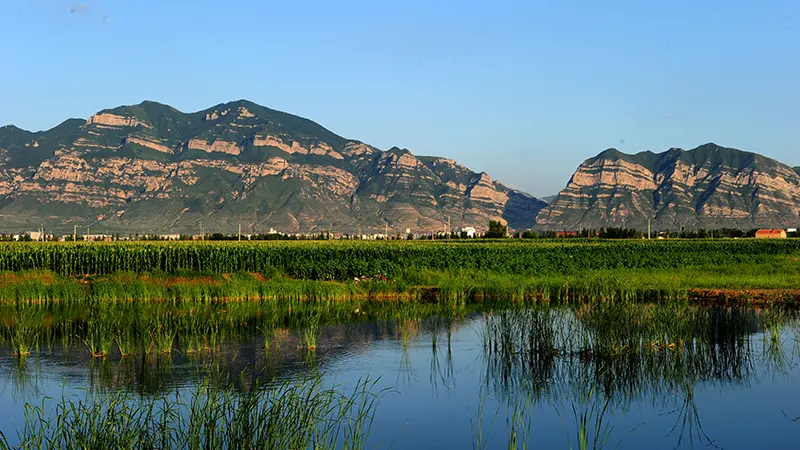
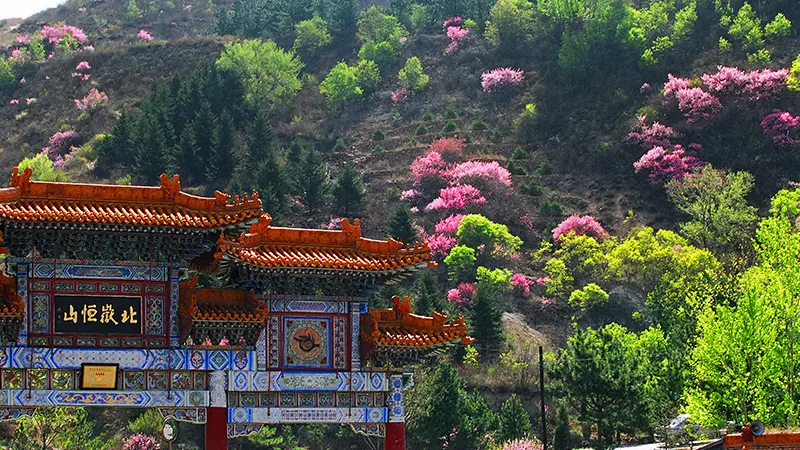
AboutMount Heng, an outstanding representative of the splendid mountains and rivers of China, a symbol of national prosperity, a totem of national spirit, an important geographical indication of the country, and holds the status of a national mountain.More
-
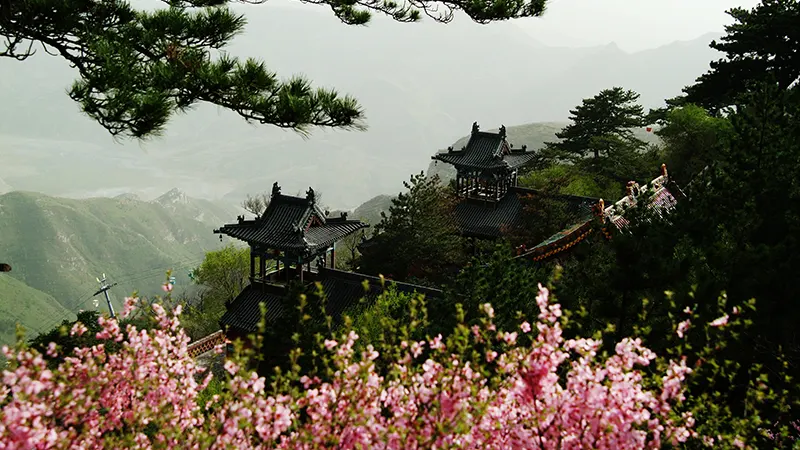
CultureHengshan has been a famous scenic spot and important birthplace of Taoism in northern China since ancient times. Carrying the symbols of Chinese civilization, it has nurtured profound regional culture and folk customs.More
-
-
Tourist GuideUnderstand relevant information about the scenic area and enjoy a better travel experience.More
-
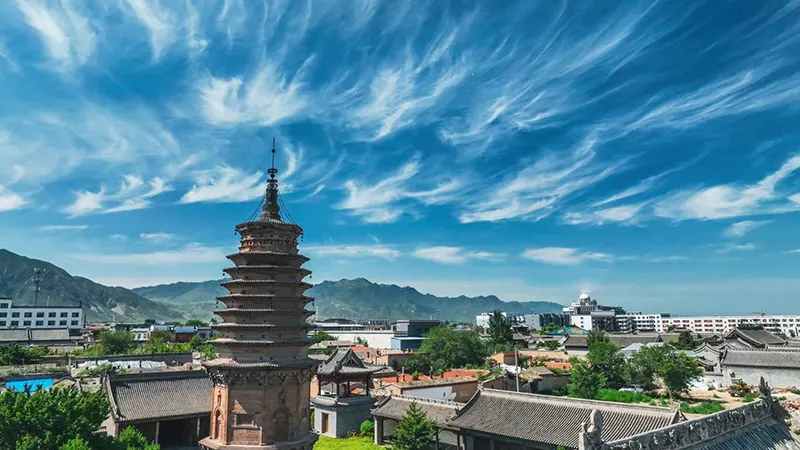
Surrounding activitiesThe ancient city of Hunyuan at the foot of Mount Heng in Beiyue has a long history, rich cultural heritage, beautiful scenery, and a convergence of agriculture, commerce, and animal husbandry. It has nurtured a unique regional culture and is renowned for its fine wine and delicious food.More






Hengshan Mountain National Scenic Area (2001-2030) Planning Text
Publish Time:
2020-10-13 16:58
Source:
Hengshan Mountain Scenic Area Master Plan (2001-2030) Revision 2016 Plan Text
Hengshan Mountain Scenic Area Master Plan (2001-2030)
2016 Revision
Planning Text
Planning Drawings
Planning Text
Planning Drawings
Hengshan Mountain Scenic Area Master Plan (2001-2030) Revision 2016 Plan Text
II
Project Name: Hengshan Mountain Scenic Area Master Plan (2012-2030) 2016
Revision
Organization and Compilation Unit: Shanxi Provincial Department of Housing and Urban-Rural Development
Shanxi Province Hengshan Mountain Scenic Area Management Committee
Undertaking Compilation Unit: Beijing Beida Urban and Rural Planning and Design Institute
Peking University, College of Urban and Environmental Sciences
Urban Planning Compilation Qualification Certificate Level: Class A
Urban Planning Compilation Qualification Certificate Number: [Jian] City Planning Compilation (141281)
Planning Results Special Seal:
Hengshan Mountain Scenic Area Master Plan (2001-2030) Revision 2016 Plan Text
III
Hengshan Mountain Scenic Area Master Plan (2001-2030) Revision 2016 Plan Text
IV
Hengshan Mountain Scenic Area Master Plan (2001-2030) Revision 2016 Plan Text
V
Hengshan Mountain Scenic Area Master Plan (2001-2030) Revision 2016 Plan Text
VI
Hengshan Mountain Scenic Area Master Plan (2001-2030) Revision 2016 Plan Text
VII
Table of Contents
Planning Text
Chapter 1 General Planning Principles.....................................................................................................................1
Chapter 2 Protection Planning.....................................................................................................................2
Chapter 3 Sightseeing Planning.....................................................................................................................7
Chapter 4 Facility Planning.....................................................................................................................10
Chapter 5 Coordinated Development Planning of Residential Areas.....................................................................15
Chapter 6 Coordination with Relevant Plans.....................................................................................................16
Chapter 7 Implementation of Short-Term Plans.....................................................................................................18
Appendix.......................................................................................................................................................19
Appendix
Appendix
Appendix
Appendix 1-1 List of Scenic Resource Types………………………………………………………………………17
Appendix 2-1 List of Cultural Relic Protection Units………………………………………………………………………19
Appendix 3-1 Scenic Area Tourist Capacity Table……………………………………………………………………21
Planning Drawings
Figure 0-1 Location Map
Figure
Location Map
Figure 0-2 Comprehensive Status Map (including eight sub-maps from 0-2-1 to 0-2-8)
Figure
Eight sub-maps)
Figure 0-3 General Planning Map (including nine sub-maps from 0-3-1 to 0-3-9)
Figure
Nine sub-maps)
Figure 1 Coordinates Map of Scenic Area and Core Scenic Area Boundary (including eight sub-maps from 1-1 to 1-8)
Figure
Eight sub-maps)
Figure 2-1 Graded Protection Planning Map (including nine sub-maps from 2-1-1 to 2-1-9)
Figure
Nine sub-maps)
Figure 3-1 Sightseeing Planning Map
Figure
Sightseeing Planning Map
Figure 4-1 Road Traffic Planning Map
Figure
Road Traffic Planning Map
Figure 4-2 Sightseeing Facilities Planning Map
Figure
Sightseeing Facilities Planning Map
Figure 5-1 Coordinated Development Planning Map of Residential Areas
Figure
Coordinated Development Planning Map of Residential Areas
Figure 6-1 Coordinated Urban Development Planning Map
Figure
Coordinated Urban Development Planning Map
Figure 6-2 Land Use Planning Map (including eight sub-maps from 6-2-1 to 6-2-8)
Hengshan Mountain Scenic Area Master Plan (2001-2030) Revision 2016 Plan Text
1
Chapter 1 General Planning Principles
Article 1 Planning Objectives
In order to actively promote the protection, utilization and management of the Hengshan Mountain Scenic Area in the new era, in accordance with the State Council's "Scenic
Area Regulations", etc., this plan is specially revised.
Article 2 Planning Scope and Area
The total area of Hengshan Mountain Scenic Area is 122.38 square kilometers. The core scenic area is the first-level protection area of Hengshan Mountain Scenic Area,
with a total area of 42.16 square kilometers, accounting for 34.5% of the total area of the scenic area (see Figure 1-1).
Article 3 Nature and Resource Characteristics of the Scenic Area
Hengshan Mountain is one of the Five Great Mountains of China, known as the Northern Mountain. Based on its magnificent and beautiful natural landscape, it is adorned with rich sacrificial culture, religious culture, and landscape culture.
The natural and humanistic landscapes are integrated, with equal emphasis on political and military significance. It has an important historical position in national
sacrificial rites and outstanding scientific, aesthetic and historical and cultural value. It is a national scenic area of mountainous type with multiple functions, including scientific research and popular science education, sightseeing and tourism,
aesthetic enlightenment, and ecological leisure.
The scenic resources of Hengshan Mountain Scenic Area include two categories, eight subcategories, and forty-one sub-subcategories. There are a total of
100 scenic spots of natural and humanistic landscapes, including 37 natural scenic spots and 63 humanistic scenic spots (see Appendix 1-1).
Its resource characteristics can be summarized as: One of the Five Great Mountains, national spirit; long history, great cultural achievements; hanging ancient temples,
world wonders; the Great Wall beacon fires, ancient war smoke; walking on Hengshan Mountain, cliffs and peaks.
Article 4 Planning Period
The planning period is 2001-2030.
Hengshan Mountain Scenic Area Master Plan (2001-2030) Revision 2016 Plan Text
2
Chapter 2 Protection Planning
Article 5 Resource Classification Protection
The plan divides the Hengshan Mountain Scenic Area into three levels: first-class protection zone, second-class protection zone, and third-class protection zone,
implementing graded control protection (see Figure 2-1).
1. First-class protection zone (core scenic area - strictly prohibited construction area)
The first-class protection zone mainly covers the surrounding areas of special-class and first-class scenic spots, with a total area of 42.16 square kilometers.
In addition to facilities for resource protection, ecological restoration, sightseeing and rest, sightseeing trails, ecological toilets, and tourist safety,
the construction of buildings unrelated to landscape protection and sightseeing is strictly prohibited, and those already built should be gradually relocated; mountain-opening and quarrying is prohibited,
deforestation and farming, digging mountains for soil, mining, etc.; trees shall not be felled; the protection, construction, and religious activities of temples and palaces
should comply with the requirements of relevant regulations on scenic areas, cultural relics, and religion; only sightseeing tours and ecological tourism
activities should be carried out, and the number of tourists should be strictly controlled; in addition to existing roads, other areas are strictly prohibited from access by external motorized transport
into the protected area; three-waste pollution is strictly prohibited, as is high-volume noise.
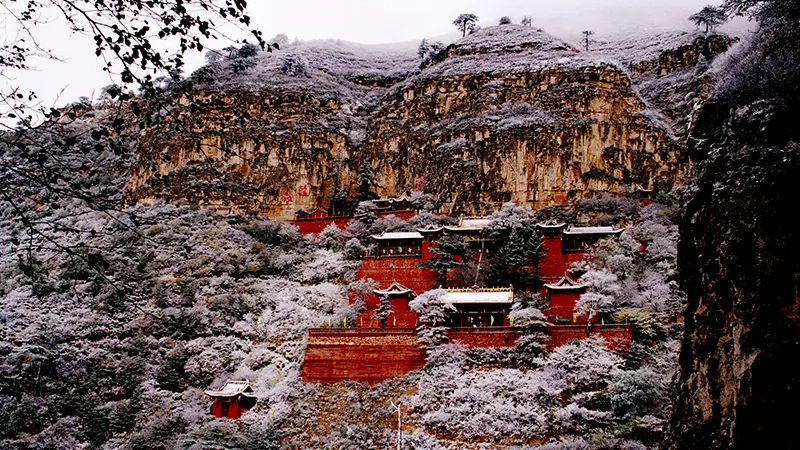
The most core areas include the Hengzong Temple, the Beiyue Palace and the surrounding buildings of the Hengshan Mountain temple group, the Hanging
Temple and its surrounding canyon environment, Yong'an Temple and its construction control area, covering an area of 0.68 square kilometers. The
ancient buildings, ancient trees, etc. in the area should be comprehensively investigated, files established, and signs posted; the repair and maintenance of cultural relics
should be carried out in accordance with national regulations on cultural relic protection, without altering the original state of the cultural relics.
2. Second-class protection zone (strictly restricted construction area)
The second-class protection zone includes the surrounding areas of second- and third-class scenic spots and areas with typical landscapes, covering an area of 54.83
square kilometers.
Develop a special plan for resource protection to further improve the forest coverage rate of Hengshan Mountain Scenic Area; trees shall not be felled at will;
Strengthen the cultivation of Hengshan Mountain native species and protect biodiversity; implement landscape and ecological restoration of damaged scenic resources; prohibit mountain-opening and quarrying,
deforestation and farming, digging mountains for soil, mining, etc.; control the scale and construction style of facilities within the area; within the area, except for the necessary service facilities construction determined by this plan,
other types of development and construction are strictly prohibited; control various engineering constructions unrelated to resource protection and landscape sightseeing; trees shall not be felled at will;
control the impact of motor vehicles on this area; strictly prohibit three-waste pollution.
3. Third-class protection zone (restricted construction area)
Hengshan Mountain Scenic Area Master Plan (2001-2030) Revision 2016 Plan Text
3
The third-class protection zone is the area within the scenic area excluding the first-class and second-class protection zones, which is an important
facility construction area or environmental background area of the scenic area, covering an area of 25.39 square kilometers.
Prohibit mountain-opening and quarrying, deforestation and farming, digging mountains for soil, mining, etc.; various construction projects should comply with the requirements of this plan,
and under the premise of not affecting resources and landscape environment, the normal production and life of the original residents can be maintained. Within a specified time limit,
govern buildings and facilities that pollute the environment and damage the landscape; control the scale of residential areas and service facilities, and sightseeing
facilities and residential areas must strictly follow the approval procedures for scenic area and urban and rural planning and construction; strictly protect
county-level and above cultural relics protection units and natural landscapes within the third-class protection zone.
Article 6 Resource Classification Protection
(1) Typical characteristic landscape
1. Sacrificial landscape
With the display of Beiyue sacrificial culture as the core, restore the Yuemen Bay (mountain gate) - Tingzhi Ridge - Zhenwu Temple - Tiger Mouth Hanging
Pine - Guolao Immortal Traces - Crocodile Stone - Temple Group Archway - Bai Xu Guan - Jieguan Hall - Xuanwu Well - King's Temple - Beiyue Palace - Baiyun Lingxu - Hengzong Temple - Huixian Mansion - Jiutian Palace - Temple Group Archway - Tingzhi Ridge - Mountain Gate complete sacrificial sequence
route, strictly protect the buildings along the sequence route, and appropriately repair them. Improve the education and display system. Carry out ecological restoration of the
mountain body around the sacrificial landscape.
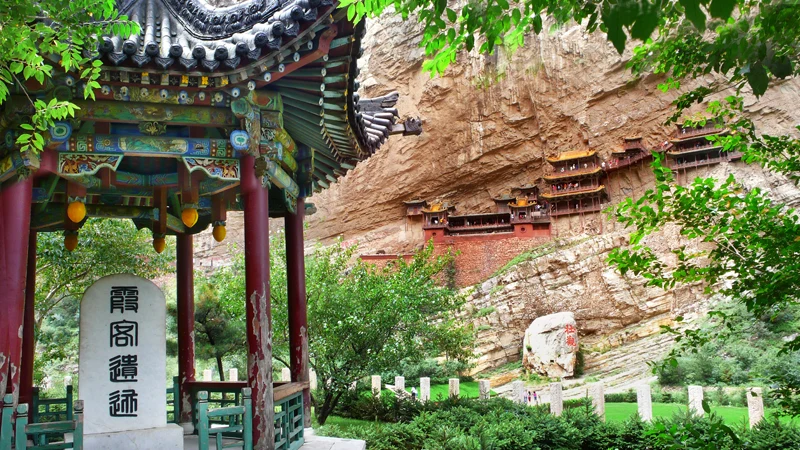
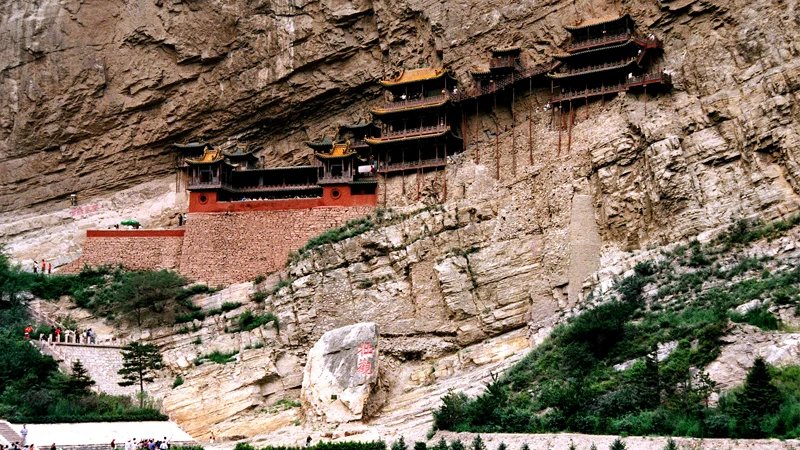
2. Hanging Temple architectural scenery
Highlight the "hanging, strange, ingenious" and "three religions in one" characteristics of the Hanging Temple, strengthen the protection of cultural relics and safety monitoring of the Hanging Temple,
strictly control the tourist capacity of the Hanging Temple, and implement the Hanging Temple access reservation system. Protect the overall appearance of Cuiping Mountain and Jinlong
Gorge, prohibit the passage of external vehicles through the gorge, cancel the existing large-scale parking lot, and gradually restore the Tangyu natural
ecological environment and historical passages such as the valley walking trail and the gorge plank road, and strive to restore the historical environment and historical
tour routes of the Hanging Temple, and protect and display the cliff carvings around the Hanging Temple.
3. Mountain and canyon landscape
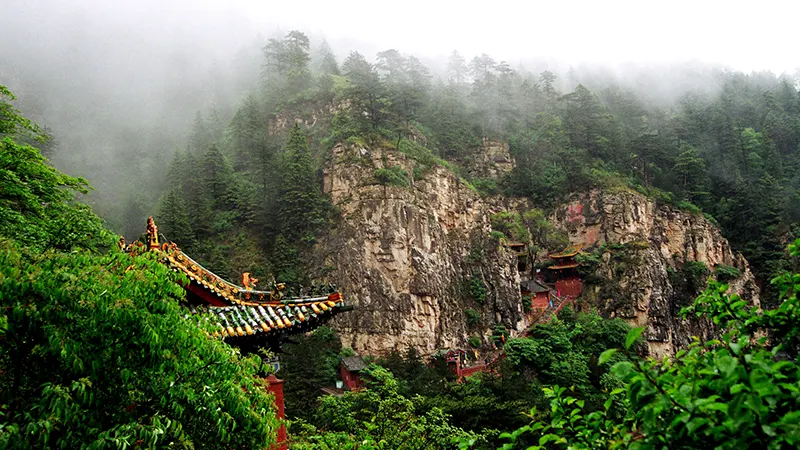
Overall protection of the Hengshan Mountain range, shaping a mountain-type landscape characterized by magnificent, strange, dangerous, and beautiful karst natural landscapes, integrating
religious, sacrificial, and ancient border war cultures, and particularly protecting the east, west, south,
north, and central five peaks where the main peak is located. Shape a canyon landscape characterized by towering peaks, beautiful grass, and murmuring streams, focusing on protection
教、祭祀、边关古战等历史文化的山岳型景观,特别保护主峰所在的东、西、南、
北、中五峰。塑造以峰峦竟秀、芳草静美、溪流潺潺为特征的峡谷景观,重点保护
Hengshan Mountain Scenic Area Master Plan (2001-2030) Revision 2016 Plan Text
4
Jinlong Gorge, Jinyxugu, Daxiaoyu Water, Longpenyuyu, Tiangou Gou, etc. Strictly prohibit mountain opening and quarrying, and promptly carry out ecological restoration in peak and valley areas where the ecological environment has been damaged.
Ecological restoration should be carried out as soon as possible in peak and valley areas where the ecological environment has been damaged.
4. Cliff Stone Carving Landscape
Conduct resource investigation and archive establishment, regularly inspect cliff stone carvings and surrounding rock formations to ensure the safety of the carvings and sightseeing; improve the cliff stone carving sightseeing and display system.
Improve the sightseeing and display system for cliff stone carvings.
5. Border Military Landscape
Focus on protecting the six scenic areas of Dianjiangtai, Shang Hualing, Dachuangling, Lingyunkou, Xi Hekou, and Tangtou Hot Spring, including the Great Wall, beacon towers, and castle ruins; number and file them, and strictly protect the cultural relics and their environment in accordance with cultural relic protection requirements.
Add explanatory and directional facilities to showcase the historical and cultural aspects.
Add interpretive signage to showcase the historical and cultural significance.
6. Ancient Village and Fort Landscape
Formulate protection and restoration plans for Wangzhuang Fort, comprehensively organize and renovate the former charm of the ancient fort, forming a tourism image of "Tour Wangzhuang Ancient Fort, Wash Royal Hot Springs".
Develop a tourism theme around "Visiting Wangzhuang Ancient Fort and enjoying the Royal Hot Springs".
7. Wetland Landscape
Strictly protect the water source areas. In accordance with water source protection requirements, any development and construction around water source areas is prohibited.
Prohibit any activities that destroy the ecological balance of the water environment, as well as activities that damage water source forests, protective banks, and vegetation related to the water source areas.
Relocate all existing polluting industrial enterprises in the Shenxi scenic area, prohibit mountain opening and quarrying within the scenic area; delineate the strictly protected area and outer protective zone of the spring eyes, and strictly protect the spring water source. Construct the Shenxi Wetland Park.
Establish a strictly protected area and outer buffer zone around the springs to ensure water source protection. Develop the Shenxi Wetland Park.
Construct Shenxi Wetland Park.
(II) Flora and Fauna Resources
Strictly protect the ecological environment of wildlife according to the protection zones, control construction and human impact, and strictly prohibit hunting.
Strictly protect forest resources through vegetation protection and restoration, including the construction of scenic forests, water source conservation forests, ecological public welfare forests, afforestation and grass planting around fields, villages and roads, and hillsides with sparse forests, thereby improving vegetation coverage.
Improve vegetation coverage through afforestation and grassland planting around cultivated land, villages, roads, and hillsides with sparse forests.
Increase vegetation coverage.
(III) Cultural Relics and Historical Sites
According to the level of cultural relic protection units, protection shall be carried out in accordance with the relevant provisions of the "Cultural Relics Protection Law".
Hengshan Mountain Scenic Area Master Plan (2001-2030) Revision 2016 Plan Text
5
Relocate settlements within the protection area and plan and improve the surrounding environment according to the historical appearance and nature of the cultural relics.
All protection measures must adhere to the principle of not altering the original state of cultural relics, strictly protecting the surrounding environment of cultural relics, and strictly protecting immovable cultural relics and intangible cultural heritage within the scenic area (see Appendix 2-1).
Strictly protect the surrounding environment of cultural relics and immovable cultural relics and intangible cultural heritage within the scenic area (see Appendix 2-1).
Article 7 Construction Control Management
Specific control management requirements for ten types of facility construction in the scenic area are proposed in accordance with the requirements of graded protection.
Specific requirements for managing construction within the scenic area are provided based on different protection levels.
Table 2-1 Overview of Graded Facility Control Management
Facility Type Level 1
Protection Area
Level 1
Protection Area
Level 2
Protection Area
Level 2
Protection Area
Level 3
Protection Area
Level 3
Protection Area
1. Roads
Transportation
Cableways, etc. × ○ ○
Motorized roads, parking lots × ○ ●
Docks △ ○ ○
Boardwalks ○ ○ -
Dirt roads ○ ○ ○
Stone paved walkways ○ ○ ○
Others × ○ ○
Tour bus stops × ○ ○
2. Catering Food stalls × △ ○
Picnic spots × △ ○
Small restaurants × × ○
Medium-sized restaurants × × ○
Large restaurants × × ○
3. Accommodation Campsites × ○ ○
Family inns × × ○
Small hotels × × ○
Medium-sized hotels × × ○
Large hotels × × ○
4. Lectures
Consultation
Exhibition halls × ○ ○
Interpretation facilities ○ ○ ○
Information centers × ○ ○
5. Shopping Banks × × △
Stalls, shops △ ○ ○
Stores × △ ○
6. Medical
Hygiene
Hospitals × × ×
Sanatoriums × × △
First-aid stations ○ ○ ○
7. Management Administrative facilities × ○ ○
Hengshan Mountain Scenic Area Master Plan (2001-2030) Revision 2016 Plan Text
6
Facilities Scenic spot protection facilities ● ● ●
Tourist monitoring facilities ● ● ●
Environmental monitoring facilities ● ● ●
8. Sightseeing
Facilities
Gazebos ○ ○ ○
Rest benches ○ ○ ○
Landscape features ○ ○ ○
9. Basics
Facilities
Post office × △ ○
Multimedia information kiosk × ○ ○
Night lighting facilities × △ ●
Emergency power supply facilities × ● ●
Water supply facilities ○ ● ●
Drainage network ○ ● ●
Garbage station × × ●
Ecological toilet ○ ● ●
Fire escape ● ● ●
Fire station ● ● ●
10. Others Science, education, and commemorative facilities ○ ○ ○
Festival and local facilities ○ ○ ○
Religious facilities ○ ○ ○
Note: ● should be set up; ○ can be set up; △ can be retained but not set up; × prohibited; - not applicable
Article 8 Ecological and Environmental Protection
Ecological and environmental protection shall be implemented in accordance with the requirements of graded protection.
Table 2-2 Ecological and Environmental Protection Requirements
Protection Area Air Environmental Quality Water Environmental Quality Environmental Noise and Traffic Noise Vegetation Coverage Rate
Level 1 Protection Area Achieves Class I Area Standard Achieves or exceeds Class II Achieves or exceeds Class 0 Area Standard Over 70%
Level 2 Protection Area Achieves Class I Area Standard Achieves or exceeds Class III Achieves or exceeds Class 0 Area Standard Over 70%
Level 3 Protection Area Better than Class I Area Standard Achieves or exceeds Class III Achieves or exceeds Class 1 Area Standard Over 60%
Note: Air environmental quality shall comply with the "Environmental Air Quality Standard" (GB3095-2012);
Surface water environmental quality shall comply with the "Surface Water Environmental Quality Standard" (GB3838-2002);
Sound environmental quality complies with the "Environmental Noise Standard" (GB3096-2008).
Hengshan Mountain Scenic Area Master Plan (2001-2030) Revision 2016 Plan Text
7
Chapter 3 Sightseeing Planning
Article 9 Tourist Capacity
The daily tourist capacity of Hengshan Mountain Scenic Area is 25,000 person-times, and the daily peak tourist capacity is 34,000 person-times (details
See Appendix 3-1).
Article 10 Featured Scenery and Exhibition
Scientifically showcase the sacrificial landscape, the Hanging Temple architectural wonders, the mountain and canyon landscapes, the cliff carvings
landscape, the border military landscape, the ancient fortress landscape, and the wetland landscape, seven characteristic landscapes, and as the core interpretation theme.
6 tourist centers (located in Tangjiazhuang, Shenxizhuang, Wangzhuangbao Town, the entrance of Tiancigu Scenic Area, thousands
Buddha Ridge Scenic Area entrance, Lingyunkou Scenic Area entrance) and 5 main tourism service points (located in Hengshan Mountain Scenic Area
Yuemen Bay, the original site of the main peak Tianfengling Stopzhi Ridge Village, the northeast side of the Hanging Temple, Shenxi Scenic Area, Tiancigu Scenic Area main
entrance) are concentrated interpretation and display venues. 13 main entrances to the scenic area (Hengshan Mountain Scenic Area and Hanging Temple Scenic Area have a total of
2, Dianjiangtai Scenic Area 1, Shenxi Scenic Area 1, Longpenyuyu, Tiancigu, Dachuangling Scenic Area each has 1
place, Qianfoling area has 2 places, Tangtou Hot Spring Scenic Area 2 places, Xihekous Scenic Area 1 place, Lingyunkou Scenic Area 1 place)
Set up scenic area entrance signs and national-level scenic area signs, and interpretation signs for important scenic spots. Along the route
Set up route signs that coordinate with the environment.
Article 11 Scenic Area Planning
1. Hengshan Mountain Scenic Area
Combining the natural features of Hengshan Mountain Scenic Area, with its towering cliffs, steep mountains, deep ravines, and strange rocks, integrating religious culture and sacrificial
culture, highlighting the cultural connotation of the scenic area. Improve the national sacrificial landscape sequence of Mount Heng, improve the education and display system, and
ecological restoration of the surrounding mountains of the sacrificial landscape. Build a mountain-type scenic area and a precious cultural heritage area with scientific research, education, Wuyue culture display, and tourism.
function.
2. Hanging Temple Scenic Area
Combining the Hanging Temple scenic area's precipitous cliffs, hanging ancient temple, and bell and waterfall landscape features, integrating Confucian, Taoist, and Buddhist
three religions culture and landscape inscription culture, strengthen the characteristics of "hanging, quiet". Gradually repair the Tangyu natural ecological environment and
Hengshan Mountain Scenic Area Master Plan (2001-2030) Revision 2016 Plan Text
8
historical passages such as the Hegu pedestrian path and the canyon plank road, and restore the natural stream landscape, the historical environment of the Hanging Temple, and
historical tour routes as much as possible, and protect and display the cliff carvings around the Hanging Temple. Build a mountain-type scenic area with scientific research, popular science, exploration and sightseeing
function.
3. Dianjiangtai Scenic Area
Combining the undulating terrain and the continuous beacon towers of the Dianjiangtai Scenic Area, highlighting the border
military cultural landscape characteristics. Thoroughly clean up and excavate the existing cultural resources in the scenic area, renovate the beacon towers, reproduce the border
landscape outside the Great Wall, open up and renovate the tour roads to the scenic area, and set up small tourism service outlets and public tour activities
Sites for activities. Construct scenic areas with functions for scientific investigation, historical site preservation, and display.
4. Chengguan Scenic Area
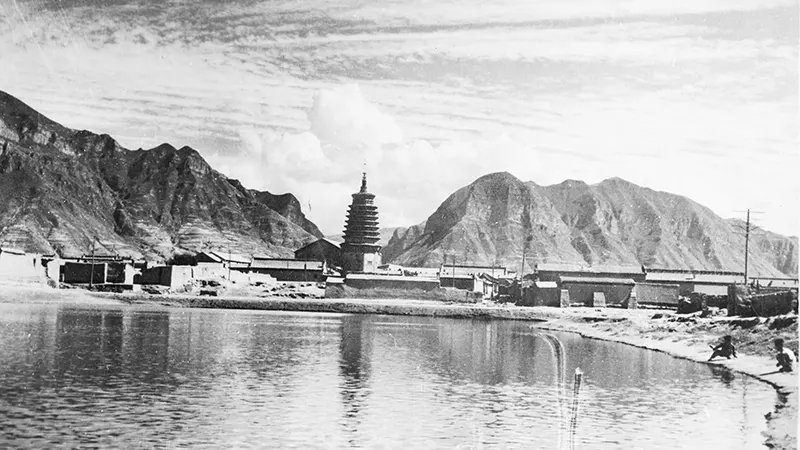
Highlight the display of cultural relics and historical sites centered around Yong'an Temple, Yuanjue Temple, and the tomb of Li Yuwei.
Clearly define the protection scope, and according to the requirements of cultural relic protection, rectify the building environment, traffic, and commercial environment within the protection scope, and strictly protect the cultural relic itself
and the overall environment. Construct a Chengguan cultural relic scenic area with the main functions of Mount Tai cultural display and historical site preservation.
5. Tianshigou Scenic Area, Longpenyü Scenic Area, Dachuangling Scenic Area
Combining the landscape features of the Tianshigou area, such as ancient temples on cliffs, peculiar peaks and deep valleys, and winding Great Walls, highlight the display of its excellent
mountain-water scenery and high-quality humanistic landscapes. Clean up and excavate, and strictly protect the existing Great Wall ruins, renovate the existing walking
paths, strengthen greening, restore vegetation, and improve the overall ecological environment of the area. Construct scenic areas with functions for tourism and leisure, and science and education.
function.
6. Shang hualing Scenic Area, Qianfo Ridge Scenic Area
Based on the mountain-type vegetation and geomorphic landscapes of the Qianfo Ridge area, highlight the display of the Great Wall and religious cultural landscape
characteristics. Strictly protect the Great Wall ruins, restore the Qianfo Temple based on scientific verification, repair the East and West Qianfo Pagoda,
cultivate scenic area vegetation, supplement the planting of autumn-colored plants, and beautify the environment. Construct a mountain-type scenic area with functions for tourism and leisure, cultural display,
and scientific research.
7. Xi Hekou Scenic Area
Combining the landscape features of the Xi Hekou Scenic Area, such as cliffs, winding Great Walls, and ancient castle scenery, highlight the display of border military
landscape. Clean, excavate, and repair the Great Wall and beacon tower ruins in the scenic area, restore vegetation, beautify the environment, and restore
the atmosphere of the ancient Great Wall. Construct a humanistic scenic area with functions for tourism and leisure, cultural display, scientific research, and education.
Hengshan Mountain Scenic Area Master Plan (2001-2030) Revision 2016 Plan Text
9
Area.
8. Tangtou Hot Spring Scenic Area
Combining the border military landscape of the Tangtou Hot Spring Scenic Area, highlight the display of border forts, smoke towers, and other humanistic
landscape features and the Tangtou Hot Spring leisure culture. Restore vegetation, purify water sources, and carry out overall
greening and beautification of the hot spring health resort environment. Construct a humanistic scenic area with functions for health and leisure, and science and education.
9. Lingyunkou Scenic Area
Combining the ancient Great Wall, beacon tower ruins, and mountain valley natural scenery of the Lingyunkou area, highlight the display of the unique military cultural landscape of the ancient war smoke
cloud. A military culture square will be built north of Lingyunkou Fort, the ancient Lingyunkou Fort will be repaired, greening will be strengthened, vegetation will be restored, and the historical atmosphere of the ancient Great Wall will be recreated.
Construct a mountain-type scenic area with functions for scientific research, science and education, cultural display, and tourism and leisure.
10. Shenxi Scenic Area
Highlight the display of wetland humanistic landscapes in the Shenxi Scenic Area, mainly the Lüyü Shrine and the Shenxi Wetland.
Sort out and excavate the water sources in the scenic area, strengthen the greening of Shenxi Mountain, restore Fengshan Academy, and add to the cultural atmosphere of the scenic area.
Construct a wetland scenic area integrating ecological protection, scientific research, science and education, and leisure experiences (see Figure 3-1).
Hengshan Mountain Scenic Area Master Plan (2001-2030) Revision 2016 Plan Text
10
Chapter 4 Facility Planning
Article 12 Road Traffic Planning
1. External Transportation Planning
Construct the Hunyuan-Wutai Mountain and Hunyuan-Yingxian expressways, and open the Datong-Hun Yuan, Hun Yuan-Wutai Mountain,
Hun Yuan-Yingxian Mu Pagoda tour buses.
2. Internal Transportation Planning
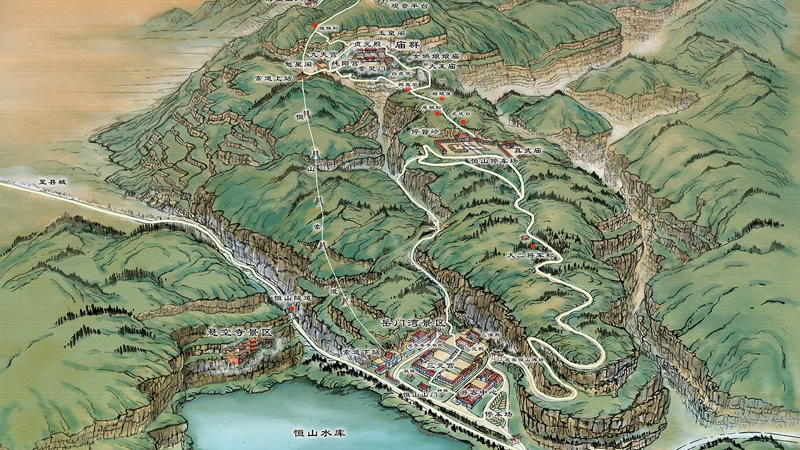
Each scenic area will build perfect walking paths; relocate the Hengshan Mountain Tianfengling cable car, with the upper station located in Baicaoping and the lower station
located in Yuemenwan; the existing motor vehicle road section from Tangjiazhuang parking lot to Xiapanpu parking lot and from Yuemenwan to Tingzhiling will be
transformed into internal scenic roads; the original trails in Jinlongxia will be repaired; the special purpose trail from the county road to the beacon tower in the Dianjiangtai Scenic Area will be repaired;
a boat dock will be set up in the Shenxi Scenic Area, forming three main routes: a mountain tour route, a water tour route, and a humanistic landscape route.
3. Traffic Facility Planning
Two large parking lots will be set up in Tangjiazhuang and Xiapanpu in the Hengshan Mountain Scenic Area; the scale will be over 8000 square meters,
with more than 200 parking spaces. Medium-sized parking lots will be set up in Luozizhawa Village in the Dianjiangtai Scenic Area, Tingzhiling and Hezhimen in the Hengshan Mountain Scenic Area, the main entrance of the Shenxi Scenic Area,
Jiangtang Village in the Shang hualing Scenic Area, the main entrance of the Qianfo Ridge Scenic Area, Wangzhuangbao Town in the Tangtou Hot Spring Scenic Area,
and Lingyunkou Village in the Lingyunkou Scenic Area; the scale will be 2000-5000 square meters,
80-200 parking spaces. Small parking lots will be set up in Huangtupo in the Longpenyü Scenic Area, Dachuanling Village in the Dachuangling Scenic Area, after the entrance of the Tianshigou Scenic Area,
Yangjiazhuang in the Shang hualing Scenic Area, Huangtupo Village in the Qianfo Ridge Scenic Area, Tangtou Hot Spring, Xi Hekou Village on the west side of the Ant River in the Xi Hekou Scenic Area, and Taianling Village,
and Zhangwang Village in the Lingyunkou Scenic Area; the scale will be 20-50
parking spaces.
4. Road and Traffic Facilities Control Requirements
Road construction should connect to the internal and external road networks of the scenic area and conform to the overall land use plan. Based on landscape environmental
protection, the route should be selected according to local conditions, and the road width should not exceed 7 meters. The scenic area should adopt an environmentally friendly internal transportation system,
and outside motor vehicles are prohibited from entering in principle. An ecological parking lot should be constructed. Traffic signs should be
coordinated with the surrounding environment (see Figure 4-1).
Hengshan Mountain Scenic Area Master Plan (2001-2030) Revision 2016 Plan Text
11
Article 13. Planning of Sightseeing Facilities
Planned sightseeing facilities are divided into tourist cities, main tourist service bases (tourist cities), primary service centers (tourist towns), secondary service centers (tourist villages),
tertiary service centers (tourist service points), service departments, visitor centers, and
campsites, totaling 8 levels (see Figure 4-2).
Table 4-1 Overview of Sightseeing Facility Planning Projects
Level Location Content
Tourist City Datong City
Star-rated hotels, restaurants, travel agencies, stations, banks, post offices, shops,
restaurants, public security, hospitals, etc.
Tourist City Hunyuan County
Sound travel, sightseeing, dining, accommodation, shopping, entertainment, medical
care, transportation transfer centers and other facilities
Tourist Towns Qianfo Ling Township, Da Ci Yao Town, Wangzhuangbao Town
External transportation, hotels, restaurants, entertainment halls, shops, banks, post
offices, hospitals, emergency centers, parking lots, public toilets, telephone booths,
signage, etc.
Tourist Villages
Luoziwa Village, Dachuangling Village, Jiangtang Village, Tang
Tou Hot Springs, Lingyunkou Village, Shenxi Village, Longpen
Yu Scenic Area Huangtupo Village, Shang Hualing Village, Xia Hualing
Village, Longzui Village, Qianfo Ling Scenic Area Huangtupo
Village, Xi Hekou Village, Taianling Village, Zhangwang Village
Catering, shopping, health care, publicity and consultation, cold food points, drinking water
points, public toilets, seats, signs, accommodation
Tourist Service
Points
Yuemen Bay, original site of Tingzhi Ling Village, Hanging Temple Tourism
Service Point, Shenxi Wetland, Tiangou Scenic Area
Entrance
Shopping, health care, publicity and consultation, cold food points, drinking water points, public
toilets, seats, signs
Visitor Centers
Tangjiazhuang, Tiangou Scenic Area Entrance, Qianfo
Ling Scenic Area Entrance, Wangzhuangbao Town, Lingyunkou
Scenic Area Entrance, Shenxi Village
Guided tours, parking, external transportation, restaurants, shops, banks,
post offices, communication points, signs
Campsites
Xia Hualing, Qianfo Ling, Lingyunkou, Longpenyu,
Dajianshan
Campsite equipment rental management office
The total land area for tourism facilities in Hengshan Mountain Scenic Area is 80.89 hectares, accounting for 0.62% of the scenic area.
The total number of beds serving Hengshan Mountain Scenic Area should reach 12,540, of which the scenic area is controlled at
3,370. The specific spatial distribution of the number of beds in each tourist city, town, and village is shown in Table 4-2.
Table 4-1 Spatial Distribution of Tourism Service Beds
Service System Location Near term Long term
Relationship with Scenic Area
Tourist City Hunyuan County City 2220 6170 Outside the scenic area
Hengshan Mountain Scenic Area Master Plan (2001-2030) Revision 2016 Plan Text
12
Tourist Towns
Qianfo Ling Township 400 1500
Da Ci Yao Town 400 1500
Wangzhuangbao Town 200 300
Within the scenic area
Tourist Villages
Luoziwa Village 120 200
Dachuangling Village 60 100
Jiangtang Village 80 120
Tangtou Hot Springs 400 600
Lingyunkou Village 150 300
Shenxi Village 100 500
Longpenyu Huangtupo Village 50 100
Shang Hualing Village 100 200
Xia Hualing Village 100 200
Longzui Village 50 100
Qianfo Ling Huangtupo Village 50 100
Xi Hekou Village 30 50
Taianling Village 100 200
Zhangwang Village 100 300
Total 4710 12540
Within the scenic area, 1690 3370
Service facility buildings are planned and constructed strictly in accordance with the approval procedures. The height, form, style, volume,
building materials, and colors should reflect the local vernacular architectural style and harmonize with the natural environment. The height of service facilities within the scenic area
is generally controlled to within 10 meters.
Article 14: Infrastructure Planning
1. Water Supply and Drainage Planning
It is predicted that the daily water consumption in the scenic area will reach 3515 cubic meters by 2030, with wastewater discharge of 2813 cubic meters.
The Hengshan Mountain scenic area's domestic and fire water supply comes from three sources: the Hengshan Mountain Reservoir, a self-owned fire water well, and the Dazibawan Spring;
the Hanging Temple scenic area's drinking water is self-supplied, and fire water comes from the Hengshan Mountain Reservoir; the Tangtou area relies on the Tangtou town area;
the Tianscigou area's domestic and fire water supply relies on Qingciyao Township, the Qianfo Ling area relies on Qianfo Ling Township, the Xi Hekou scenic area relies
on Wangzhuangbao Town, the Lingyunkou scenic area relies on Peicun Township, the Shenxi scenic area relies on Hunyuan County city, and the Shenxi Reservoir unified water supply.
The water supply standard shall comply with the "Standard for Drinking Water" (GB5749-2006).
Rainwater is drained into nearby mountain valleys and streams; Hengshan Mountain scenic area public toilets use water-saving and environmentally friendly toilets; wastewater is treated on-site, and
consideration is given to the irrigation use of wastewater; remote scenic area public toilets use ecological toilets, and service area wastewater uses
ecological wastewater treatment or is connected to the urban sewage pipe network for unified treatment. The treatment standard shall comply with the "Discharge Standard of Pollutants for Urban Sewage Treatment Plants" (GB18918-2002).
Hengshan Mountain Scenic Area Master Plan (2001-2030) Revision 2016 Plan Text
13
2. Power and Telecommunications Planning
The Hunyuan 220-kilovolt substation is the main power supply for the Hengshan Mountain scenic area.
100% communication network coverage of the scenic area will be achieved within two years; public telephones will be installed at all major scenic spots, service points, hotels, and guesthouses.
3. Sanitation Facilities Planning
Garbage collection points and public toilets will be set up at tourist service points and sightseeing routes. Domestic garbage will be collected in bags, and
solid waste will be transported to the sanitary landfill for centralized treatment. Waterless ecological toilets will be installed throughout the core scenic area.
4. Comprehensive Disaster Prevention Planning
1) Flood Control Planning
According to the "Flood Control Standard" (GB50210-94) and the "Urban Flood Control Engineering Design Code" (CJJ50-92),
the Tangyu River urban section is designed to a 50-year flood control standard, and the dyke level is level 4.
2) Fire Protection Planning
Strictly control fire sources; improve the fire resistance of reconstructed ancient buildings, and set up fire and lightning protection facilities; power distribution and
power lines should be protected by non-combustible material pipes.
3) Natural and Geological Disaster Planning
Strengthen and improve disaster early warning, conduct investigations of disaster hidden dangers; combine biological measures with engineering measures; strengthen
the role of social and administrative management.
4) Biological Disaster Prevention and Control Planning
Establish a specialized department for biological disaster prevention and control to implement comprehensive detection coverage and conduct regular inspections of the scenic area; use biological
prevention and control, forestry prevention and control, and physical prevention and control as the main methods.
5) Tourist Safety Service Planning
Establish a scenic area disaster early warning system, and set up warning signs or no-entry signs in dangerous areas of the scenic area;
establish an emergency rescue system and formulate procedures for handling accidents.
Hengshan Mountain Scenic Area Master Plan (2001-2030) Revision 2016 Plan Text
14
6) Emergency Shelter Planning
Formulate special safety measures for the high incidence period of natural disasters, and formulate multiple emergency rescue plans for potential natural disasters in the scenic area; establish a computer-aided emergency decision support system.
Hengshan Mountain Scenic Area Master Plan (2001-2030) Revision 2016 Plan Text
15
Chapter 5: Coordinated Development Planning of Residential Areas
Article 15: Types of Residential Area Control
Three relocation-type residential areas, three reduced-size residential areas, and 20 controlled residential areas are planned within the scenic area.
The planned resident population is 6630, with approximately 1915 people relocated; the planned resident social construction land area is 176.52 hectares,
reduced by approximately 21.47 hectares; the per capita construction land area is approximately 266.24 square meters (see Figure 5-1).
Article 16: Measures for Residential Area Control
Protect the legitimate rights and interests of the original residents within the scenic area according to law, and reasonably control the construction and population size of residential areas.
Residential areas within the core scenic area should be gradually relocated on the premise of respecting the wishes of the residents, ensuring that the rights and interests and living standards of the residents are not lowered.
The Hengshan Mountain scenic area and the Hanging Temple scenic area are uninhabited areas and should be prioritized for relocation; the Pointing Platform scenic area,
Shang Hualing scenic area, Dachuanling scenic area, Longpenyu scenic area, Tianscigou scenic area, and Lingyunkou scenic area are areas with declining populations,
and the number of permanent residents should be reduced. Residents are encouraged to gradually move to the plains areas according to local policies, or to consolidate multiple villages
and merge them, and moderately utilize and transform them into tourism service bases; the Shenxi scenic area, Tangtou Hot Spring area, Xi Hekou scenic area,
Qianfo Ling scenic area, and Chengguan scenic area are controlled residential areas, and control indicators should be formulated to adjust the existing number of residents.
Relocated land will mainly be used for ecological restoration.
Hengshan Mountain Scenic Area Master Plan (2001-2030) Revision 2016 Plan Text
16
Chapter 6: Relevant Planning Coordination
Article 17: Coordination of Urban Planning and Peripheral Area Protection
Based on the "Hunyuan County Urban Master Plan" (2010-2020), the boundary lines of the scenic area and the city should be coordinated.
The "four lines" should be coordinated and controlled. The "four lines" refer to the urban green line, urban blue line, urban purple line, and urban yellow line.
Based on the relationship between the scenic area and its surrounding areas and its construction control requirements, future urban spatial development should be coordinated with the development of the scenic area.
Urban development boundaries are prohibited from entering the planned scenic area's peripheral protection zone. Urban construction land is strictly prohibited from encroaching on scenic area land.
Strictly control the "two areas and three lines." The "two areas" refer to Hunyuan urban area and the Hengshan Mountain front area.
The "three lines" refer to Hengshan Mountain (Tianfengling) - Yong'an Temple, Yuanjue Temple area - Shenxi Mountain; Hengshan Mountain (Tianfengling) - Li Yu Mei Tomb; Shenxi Wetland - Hengshan Mountain (Tianfengling).
Control the building height within the viewing control area and establish visual corridors.
New urban spatial expansion should coordinate with the scenic area and the landscape environment to build a harmonious spatial relationship, protecting the historical landscape pattern of "mountains, water, fields, and city" (See Figure 6-1).
Article 18: Land Use Planning Coordination
Implement relevant regulations such as the "Land Management Law," with the goal of actively protecting the ecological environment, while also considering the needs of residents' lives and tourism activities.
Appropriately increase scenic and recreational land and control the scale of construction land (See Figure 6-2).
Table 6-1 Hengshan Mountain Scenic Area Land Use Control Table
Hengshan Mountain Scenic
Area
Land Use Classification Planning Land Area (
Land Use Classification Planning Land Area (ha) Percentage (%) Current Land Area (ha) Percentage (%)
Area
Land Use Classification Planning Land Area (
Scenic and Recreational Land 1028.13 7.92 218.73 1.79
Tourism Facilities Land 80.39 0.62 8.88 0.07
Residential and Social Land 176.52 1.36 197.99 1.62
Transportation Engineering Land 550.76 4.24 359.28 2.95
Forest Land 9234.25 71.16 9538.29 78.2
Orchard Land 325.04 2.50 330.3 2.71
Cultivated Land 1002.83 7.73 986.2 8.08
Grassland 186.7 1.44 147 1.21
Water Area 359.85 2.77 351.03 2.88
Reserved Land 32.89 0.25 60.3 0.49
Total 12977.36 100 12238 100
Article 19: Coordination of Other Relevant Plans and Management Regulations
1. Ecological Environmental Protection
Implement relevant regulations such as the "Environmental Protection Law," and coordinate the implementation of plans related to ecological environmental protection.
Hengshan Mountain Scenic Area Master Plan (2001-2030) Revision 2016 Plan Text
17
Strengthen ecological environmental protection, implement relevant measures and requirements of planning environmental impact assessments, and relevant construction projects should fulfill environmental impact assessment procedures.
2. Water Resource Protection
Implement relevant regulations such as the "Water Law," and coordinate the implementation of the "Shanxi Province Surface Water Water Environmental Functional Zoning" (January 2014).
Strengthen water resource protection, strictly manage water areas and shorelines, and carry out mountain flood and geological disaster prevention.
3. Forest Land and Specific Area Protection
Implement relevant regulations such as the "Forest Law" and the "Nature Reserve Regulations," strictly protect forest land and forest resources, and coordinate the implementation of the overall plan for the Hengshan Mountain Provincial Nature Reserve and the overall plan for the Hengshan Mountain Provincial Forest Park.
4. Cultural Relic Protection
Implement relevant regulations such as the "Cultural Relic Protection Law," and coordinate the implementation of special plans for cultural relic protection.
Implement the management requirements of cultural relic protection areas and construction control zones. Projects involving the repair, reconstruction, and new construction of cultural relics and historical sites must strictly follow relevant approval procedures.
5. Management of Religious Activity Venues
Implement relevant regulations such as the "Regulations on Religious Affairs," clarify legally registered religious activity venues within the scenic area, and maintain the surrounding environment and landscape of religious activity venues.
6. Tourism Management
Implement relevant regulations such as the "Tourism Law," regulate tourism and tourism business activities, improve tourism facilities, and improve the level of tourism services.
Chapter 7: Implementation of Short-Term Plans
Article 20: Key Points of Short-Term Implementation
1. Strictly protect the natural resources, cultural resources, and ecosystems of the Hengshan Mountain Scenic Area, especially the Hengshan Mountain sacrificial culture sequence, Hanging Temple, and Yong'an Temple, and other historical buildings, truly and completely reflecting the historical, cultural, scientific research, and aesthetic value of the Hengshan Mountain Scenic Area.
2. Improve the management mechanism and implement comprehensive management of the Hengshan Mountain Scenic Area.
3. Formulate management regulations for the Hengshan Mountain Scenic Area. Accelerate the work of improving boundary markers and signs in the scenic area.
4. Improve infrastructure, strengthen the connection between scenic spots, and promote the overall development of the Hengshan Mountain Scenic Area.
Hengshan Mountain Scenic Area Master Plan (2001-2030) Revision 2016 Plan Text
18
第七章 近期规划实施
第二十条 近期实施重点
1、严格保护Hengshan Mountain风景名胜区的自然资源、文化资源和生态系统,尤其是Hengshan Mountain祭
祀文化序列、悬空寺、永安寺等历史建筑,真实完整地体现Hengshan Mountain风景名胜区的历史
文化、科学研究和审美价值;
2、完善管理机制,对Hengshan Mountain风景区实施全面管理;
3、制订Hengshan Mountain风景名胜区管理条例。加快风景名胜区界桩、标识标牌完善工作;
4、完善基础设施,加强景区联系,促进Hengshan Mountain风景区整体发展;
5. Quarrying, mining, and any other activities violating the scenic area regulations and overall plan are strictly prohibited within the scenic area.
Ecological restoration measures should be taken as soon as possible to address the topographical damage caused by highway construction and other projects.
6. Based on the overall plan, detailed planning for key sightseeing facilities construction areas should be completed as soon as possible.
Hengshan Mountain Scenic Area Master Plan (2001-2030) Revision 2016 Plan Text
19
Appendix
Appendix 1-1 Scenic Resources Type Table
Category Sub-category Sub-sub-category Representative Scenic Resources
Natural
Scenic Resources
Sky Scenes
Sun, Moon, Stars and Light (1) Hengshan Mountain Sunrise (2) Sunset Glow (3) Shenxi Moonlit Night
Rainbow, Haze, and Mirage (1) Sunset Glow (2) Hengshan Mountain Spiritual Light (3) Dangerous Cliff Sunset
Wind, Rain, Sunshine, and Clouds
(1) Ci Xia Misty Rain (2) Suspended Beads and Ripples (3) Tiger Wind Pass (4) Yue Top Pine Wind
(5) Hengshan Mountain Listening to the Rain
Climate Phenomena (1) Cloud Road Spring Dawn (2) Eternal Scenery of Four Seasons
Natural Sounds (1) Birds Singing on the Cliff (2) Golden Rooster Crow (3) Listening to Thunder from Afar
Cloud and Mist Scenery (1) Jade Sheep Floating Clouds (2) Ziyu Cloud Flowers (3) White Cloud Spiritual Cave (4) Hengshan Mountain Floating Clouds
Ice, Snow, Frost, and Dew (1) Hengshan Mountain Snow After a Clear-up (2) Cui Ting Viewing Snow (3) Hengshan Mountain Snow Pine
Earth Scenes
Mountain Scenery
(1) Tianfeng Ridge (2) Cuiping Mountain (3) Long Mountain (4) Thousand Buddha Ridge (5) Five Peaks Mountain
(6) Maogong Mountain (7) Tianshan Mountain (8) Wangmao Mountain (9) Sun Bin Village;
Gorge
(1) Jinlong Gorge (2) Longpenyu (3) Baoyu Gou (4) Zizhiyu (5) Tongyuangou
(6) Tiansai Gorge (7) Ci Xia Misty Rain (8) Ziyu Cloud Flowers (9) Lingyunkou Small Valley
Cave
(1) Jixian Cave (2) Zixia Cave (3) Guolao Cave (4) Yuhuang Cave (5) Chuyun Cave
(6) Huanyuan Cave (7) Zongzhen Cave (8) Peach Blossom Cave (9) Arhat Cave (10) Bodhidharma Cave
(11) Bifeng Cave
Stone Forest and Stone Scenery
(1) Jade Sheep Floating Clouds (2) Hengyin Stone Forest (3) Thousand Buddha Ridge Strange Rocks (4) Sunset Rock
(5) Guolao Immortal Traces (6) Golden Rooster Crow (7) Qinqi Terrace (8) Yide Peak (9) Xiaoyu Stone Forest
Other Earth Scenes
(1) Monkey Gazing at the Moon (2) One Man Guards the Pass (3) Jade Dog Exploring the Road (4) Stone Wall (5) Jade Belt Bridge
(6) Hengshan Mountain Wooden Dragon (7) Black Eagle Nest (8) Self-Sacrifice Cliff (9) Shenlu Westward Journey (10) Wolonggang
(11) Road to Heaven (12) Tranquil Cliff (13) Pillar Supporting the Sky (14) Winding Path Leads to Seclusion (15) One Line Sky (16)
Songlin Terrace (17) Ten Thousand Volumes of Heavenly Books (18) Heavenly Ladder
Water Scenes
Spring and Well
(1) Tangtou Hot Spring (2) Dazibawan Spring (3) Bitter and Sweet Well (4) Shenxi Spring Water
(5) Bailong Ganquan (6) Water Curtain Cave
Stream
(1) Jinlong Gorge Stream (2) Thousand Buddha Holy Land Stream (3) Diaowanggou Stream (4) Longpenyu Stream (5)
Xiaoyu River Stream
River (1) Hun River (2) Tang River (3) Ant River
Lake (1) Hengshan Mountain Reservoir (2) Shenxi Reservoir
Waterfall (1) Guangyakou Waterfall Group (2) Yunfeng Temple Waterfall (3) Longwanggou Waterfall (4) Xiaoyu Valley Waterfall
Life Scenes
Forest (1) Hengshan Mountain Forest Park (2) Longshan Primeval Forest (3) Fuling Pine Waves
Ancient Trees and Famous Trees
(1) Hengshan Mountain Zelkova (2) Hengshan Mountain Ancient Pine (3) Shuangsong Temple Pine (4) Lingyunkou Pine
(5) Hengshan Mountain Sister Pine (6) Tiger Mouth Hanging Pine (7) Hengshan Mountain Four Great Doctor Pines
Rare Animals and Plants (1) Hengshan Mountain Astragalus (2) Leopard Pine (3) Picea koraiensis (4) Picea asperata (5) Leopard (6) Red Fox
Plant Ecological Groups
(1) Hengshan Mountain Oil Pine Forest (2) Birch Forest (3) Picea koraiensis, Picea asperata Forest (4) Hengshan Mountain Mountain Peach
(5) Hengshan Mountain Celtis sinensis (6) Brocade Valley (7) Shang Hualing Alpine Meadow (8) Shenxi Wetland
Hengshan Mountain Scenic Area Master Plan (2001-2030) Revision 2016 Plan Text
20
Animal Habitats (1) Hengshan Mountain Forest Area (2) Longshan Nature Reserve (3) Shenxi Wetland
Phenological Landscape (1) Shenxi Swans (2) Hengshan Mountain Grey Geese (3) Fuling Red Leaves (4) Hengshan Mountain Red Leaves
Humanities
Scenic Resources
Garden Scenery Cemetery (1) Li Yu Mei's Tomb
Architecture
Scenic Architecture
(1) Jin Dynasty Yuanjue Temple Brick Pagoda (2) Lǜlǜ Shrine (3) Hengshan Mountain Front Archway (4) Hengshan Mountain Rear Mountain Gate
Archway (5) Hezhi Gate (6) Hengshan Mountain Screen Wall (7) Hanging Temple Signpost (8) "Human Heaven North Pillar" Sign
Archway (9) Imperial Stele Pavilion
Residential Houses and Ancestral Shrines (1) Li Family Mansion (2) Xue Family Mansion (3) Tian Yinghuang Residence (4) Ma Guohua Residence
Entertainment Buildings (1) Cui Ping Academy (To be restored) (2) Fengshan Academy (To be restored)
Palaces and Government Offices (1) Hunyuan Prefecture Office
Religious Buildings
(1) Hanging Temple (2) Sanqing Hall(*) (3) Zhenwu Temple(*) (4) North Peak Palace (5) Hui Xian Mansion
(6) Jiutian Palace (7) Chunyang Palace (8) Ten Kings Hall (9) Yong'an Temple (10) North Peak Imperial Palace (11)
Bai Long Wang Hall (12) Yunfeng Temple (13) Thousand Buddha Pagoda (14) Jingju Temple
Memorial Buildings (1) Revolutionary Martyrs' Tower
Scenic Spots
Remains and Ruins
(1) Ancient Great Wall Ruins (2) Beacon Tower Ruins (3) Hengshan Mountain Ancient Plank Road Ruins (4) Mu Guiying's General's Platform
Platform (5) Taianling Ancient Fortress (6) Wangzhuang Fort Ancient Castle (7) Liulang City Remains (8) Baima Temple Ruins
Cliff Inscriptions
(1) Hengshan Mountain Dazibawan "Hengzong" Inscription (2) Hanging Temple "壮观" Inscription (3) Hengshan Mountain Hui Xian
Mansion Cliff Inscription Group (4) Hengshan Mountain Palace Cliff Inscription Group (5) Qinqi Platform Stone Carving Group (6) Thousand Buddha Ridge
"Yuezong" Stone Carving (6) Taking Xuanzhiji Stele (7) Emperor Kangxi's "化垂悠久" Stele (8)
Stopping Order Stele (9) "腾云皈梦" Stone Carving (10) "空中色相" Stone Carving (11) "天下巨观"
Stone (12) "云边觉岸" Stone Carving (13) "佛" "和" "禅" Stone Carvings
Stone Caves (1) Feishi Cave (2) Sanmao Cave (3) Thousand Buddha Cave
Sculpture
(1) Hanging Temple Unspooled Buddha Statues (2) Hanging Temple Stone Buddha Statues (3) Hengshan Mountain Temple Group Hall Deities (4)
Hengshan Mountain Zhang Guolao Sculpture (5) Li Yu Mei's Tomb Stone Statue (6) Thousand Buddha Ridge Thousand Buddha Cave Stone Carvings
Others (1) Yong'an Temple Yuan Dynasty Wall Paintings (2) Lǜlǜ Shrine Ming Dynasty Wall Paintings (3) Dayun Temple Ming Dynasty Wall Paintings
Local Products
Religious Rituals (1) Hengshan Mountain Sacrificial Activities (2) Hengshan Mountain Taoist Religious Services
Myths and Legends
(1) Hengshan Mountain Scenic Spot Legends (2) Hengshan Mountain Qionglongquan Legend (3) Thousand Buddha Ridge Sun Bin Village, Pang Juan Ridge,
Laojun Temple Legend (4) North Peak God Legend (5) Sanmao True Monarch Legend (6) Guolao Immortal Traces Legend (7)
Cliff Bird Cry Legend
Folk Arts
(1) Hunyuan Fan Dance (2) Hunyuan Stilts (3) Hunyuan Stories (4) Hunyuan Chess
(5) Hunyuan Yangge
Local Figures
(1) Liu Wei, Jinshi Scholar (2) Famous Writer Liu Qi (3) Shangshu Youcheng Su Baoheng
(4) Yong'an Jiedushi Gao Ding (5) Jin Dynasty Yi Scholar Lei Si (6) Yuan Dynasty Armor Expert Sun Wei,
Sun Gongliang (7) Qing Dynasty Yellow River Control Official Li Yu Mei (8) Qing Dynasty Junior Grand Secretary Zhao Guoliang (9) Early Republic of China Shanxi
University President Tian Yinghuang (10) Anti-Japanese General Shi Zuoheng
Local Products
(1) Granite (2) Hengshan Mountain Astragalus (3) Hengshan Mountain Mushrooms (4) Lotus Beans (5) Little Daughter-in-Law Jelly (6)
Fluorite, Bentonite
Note: "*" indicates religious activity sites open within the scenic area.
Hengshan Mountain Scenic Area Master Plan (2001-2030) Revision 2016 Plan Text
21
Appendix 2-1-1 List of Cultural Relic Protection Units
Number Name Location Level Composition and Current Status Planning Measures
1 Hanging Temple
Hanging Temple
Scenic Area
National Level
More than forty halls and pavilions, preserved
Intact
Further improve protection measures, strictly calculate and control
Tourist volume, rectify the overly artificial square environment,
Try to restore the natural habitat of the river, reduce traffic vibration,
Pollution affecting the temple.
2 Yong'an Temple
Chengguan Scenic
Area
National Level
All renovations are completed, maintaining the original appearance, strengthening the protection of murals, and improving the surrounding
environment
3 Yuanjue Temple
Chengguan Scenic
Area
National Level
The temple is destroyed, only the brick tower remains, well preserved
Intact, partially damaged
Strictly protect the temple tower building, moderately renovate supporting facilities,
Gradually improve the surrounding environment
4
Li Yu Mei
Tomb
Chengguan Scenic
Area
National Level
Well preserved, maintain the original appearance of the cultural relics, control the height of surrounding buildings
5
Lü Lǚ Shén
Shrine
Shenxi Scenic
Area
National Level
Main hall, bell and drum tower, five-dragon wall and
Side halls are well preserved, surrounding
The environment is relatively chaotic
Comprehensive protection of buildings and internal space environment, rectify
External space environment, especially the village environment, strengthen the surrounding
Water body environment management
6 Hengzong Hall
Hengshan Mountain Scenic
Area
Provincial level
Mountain gate, Qinglong Hall, Baihu Hall,
Side halls, archway, ear halls, bell and drum
Tower, changing room, Sutra repository. Building
Except for Qinglong and Baihu Halls, the damage is serious
Heavy, all are well preserved
Strictly protect the authenticity and integrity of the building complex. Add
Strengthened dynamic monitoring and scientific renovation, protecting the cliffs
Of the cliff inscriptions
7 Huixianfu
Hengshan Mountain Scenic
Area
Provincial level
Main hall, Yuhuang Pavilion, Imperial Stele Pavilion.
The current situation is well preserved
Renovation of the entire building complex and internal space environment, rectification
External environment, repair cliff inscriptions
8
Bei Yue Qin
Palace
Hengshan Mountain Scenic
Area
Provincial level
Main hall, Houtu Lady Temple, Dressing
Building. The current situation is well preserved
Renovation of the entire building complex and internal space environment, renovation
Cliff inscriptions, cleaning up submerged cliff inscriptions
9 Baixu View
Hengshan Mountain Scenic
Area
Provincial level
Archway, Mashend Palace, Baixu View and
Ziwei Pavilion. All are well preserved
Restoration of the entire building complex and internal space environment
10 Baiyun Hall
Hengshan Mountain Scenic
Area
Provincial level
Baiyun Hall, Longquan View, Ming Dynasty Stele Pavilion.
Buildings are relatively well preserved, Longquan Well
Kǔjǐng does not exist
Restoration of the entire building complex and internal space environment
11 Jiutian Palace
Hengshan Mountain Scenic
Area
Provincial level
Main and side halls, ear halls and bell and drum tower,
Well preserved
Restoration of the entire building complex and internal space environment, rectification
External environment
12 Kuixing Pavilion
Hengshan Mountain Scenic
Area
Provincial level
Well preserved, restore buildings and internal space environment, rectify external
environment
13 Confucian Temple
Chengguan Scenic
Area
Provincial level
All renovations are completed, further improve protection measures, rectify the environment, highlight
Architectural features
14 Chunyang Palace Hengshan Mountain Scenic Area Provincial level All renovations are completed, further improve protection measures, rectify the environment, highlight
Hengshan Mountain Scenic Area Master Plan (2001-2030) Revision 2016 Plan Text
22
Architectural features
15
Five Temples
Building complex
Hengshan Mountain Scenic
Area
Provincial level
Dragon King Temple, Guan Di Temple, Lingguan Temple,
Wenchang Temple renovation completed, Taiyi
Temple, dilapidated, not yet rebuilt
Renovation of Taiyi Temple
16
Thousand Buddha Pagoda
And Thousand Buddha
Temple
Thousand Buddha Ridge
Scenic Area
Provincial level
Thousand Buddha Temple has been destroyed, only the tower and
The Buddha Cave is well preserved. But the newly built
Thousand Buddha Temple violates the historical style
Renovation of the Thousand Buddha Pagoda and the Thousand Buddha Cave. On the basis of strict demonstration,
Restore the Thousand Buddha Temple according to its historical style
17 Sanqing Hall
Hanging Temple
Scenic Area
Provincial level
Main hall, Wenchang Pavilion, Chunyang Palace,
Baiyi Hall, Zhuyi Pavilion, Niangniang Temple
The buildings and statues are relatively well-preserved
Repair all buildings and indoor and outdoor environments
18
Bai Long Wang
Hall
Hengshan Mountain Scenic
Area
County-level
It has been rebuilt, and further improvements have been made to the environment
19 Yan Dao Shrine
Hengshan Mountain Scenic
Area
County-level
Only a small house remains, which is relatively dilapidated
and lacks original features
Rebuild the Yan Dao Shrine to restore the original landscape atmosphere and
architectural features; the building's function is for landscape sightseeing
20 Luohan Temple
Hanging Temple
Scenic Area
It has been destroyed, only the Luohan Cave remains, which is above
the water level of the reservoir and is often
flooded
Preserve the site
21 Yunfeng Temple
Tiangci Gorge
Scenic Area
Originally a three-story temple, connected by a plank road,
it has now been rebuilt
The temple has been restored in accordance with its historical appearance
22 Bifeng Temple
Thousand Buddha Ridge
Scenic Area
Destroyed; preserve the site
23 Jingju Temple
Longpenyu
Scenic Area
Destroyed; only the three-world Buddha relief carvings remain
three statues
Preserve the site
24 Cuixue Pavilion
Hengshan Mountain Scenic
Area
Destroyed; reconstruction is being considered
Appendix 3-1 Tourist Capacity Table of Hengshan Mountain Scenic Area
Main Scenic Spots
Name
Visitable Area
(Square kilometers)
Tour Length
Instantaneous Suitable
Capacity (People)
Instantaneous Limit
Capacity (People)
Daily Tourist Capacity (Person-times/
Day)
Daily Tourist Limit Capacity
(Person-times/Day)
Main Scenic Spots
Name
Visitable Area
(Square kilometers)
Tour Length
Instantaneous Suitable
Capacity (People)
Instantaneous Limit
Capacity (People)
Daily Tourist Capacity (Person-times/
Day)
Daily Tourist Limit Capacity
(Person-times/Day)
Hengshan Mountain Scenic Area, Hanging Temple
Scenic Area
0.447 19.8 3400 4900 8900 12400
Among them, Hanging Temple 0.005 170 250 850 1250
Among them, Hengshan Mountain Temple Group 0.05 1200 1800 3600 5400
Dianjiangtai Scenic Area 0.08 5.2 400 900 900 1800
Chengguan Scenic Area 0.016 / 300 300 1100 1300
Tiangci Gorge Scenic Area 0.718 7 1000 1200 1400 1700
Hengshan Mountain Scenic Area Master Plan (2001-2030) Revision 2016 Plan Text
23
Note: The tourist capacity of the scenic area in this plan is estimated using the area method and the route method. Instantaneous capacity = Visitable area size or route length ÷ per capita index;
Daily tourist capacity = Instantaneous capacity × daily turnover rate; Annual tourist capacity = Daily tourist capacity × average annual sightseeing days. The instantaneous suitable capacity, instantaneous limit capacity,
daily tourist suitable capacity, and daily tourist limit capacity in the table are rounded to the nearest hundred.
Longpenyu Scenic Area 1.61 3 1800 2100 1800 2300
Dachuangling Scenic Area 0.15 6 800 900 1600 1800
Qianfoling Scenic Area 1.08 7 2000 2900 2600 3700
Shangbhuangling Scenic Area 0.68 5 1600 1900 1600 1900
Xi Hekou Scenic Area 0.025 4.5 200 200 300 400
Tangtou Hot Spring Scenic Area 0.08 / 300 500 400 600
Lingyunkou Scenic Area 0.108 56 1300 1700 2900 3900
Shenxi Scenic Area 0.786 / 1700 2600 1700 2600
Total 5.78 176.5 14800 20100 25200 34400
Keywords:
Hengshan
Related News
Contact Us
Beiyue Hengshan Scenic Area:
Travel Inquiry:+86-352-8333077
Ticket Inquiry:+86-352-8333031
Travel Complaints:+86-352-8333081
Emergency Rescue:+86-352-8333037
Scenic Area Product After-Sales Service Hotline:
+86-18636203837
+86-15383522518
Mount Hengshan Scenic Area Administration Center (Official)
+86-352-8322142
Hanging Temple
+86-352-8327795
Yuemenwan (Hengshan Mountain Gate)
+86-352-8480060 +86-352-8328318 +86-352-8328530
Hengzong
+86-352-8480115
Tianfeng Ridge
+86-352-8480114
Yong'an Temple
+86-352-8322390
Li's Family Cemetery
+86-352-8322381
Hengshan Cableway
+86-352-8322255
Official Media

Tiktok